Showing posts with label turtle. Show all posts

Saturday, July 13, 2013

Being Bicostal means Starting with One Coast - The Atlantic Ocean - Costa Rica, Part 9

This trip took us into 6 of the 7 provinces in Costa Rica.  It's a really small country, if I haven't mentioned that before.  The comparison that always sticks in my head is that it's only half the size of the state of Kentucky.  And Kentucky is no Alaska or California, if you know what I mean.

So once we left San José, we headed for Tortugero, which is is on the Atlantic coast.  The Tortugero school, which I'll talk a bit about later, was right on the Atlantic beach.  Now, maybe it's because I see the Atlantic (well, the Gulf of Mexico) at least once a year, but I didn't find it nearly as interesting as the Pacific Coast.  I've only seen the Pacific twice in my life.  It also, I'm sure, has something to do with the particular geography of the parts of each coast that I saw.  The Pacific coast of Costa Rica, where I was anyway, was full of volcanic tide pools.  The Atlantic beach was, well, just sand.

That's not to say that it wasn't pretty.


All said, it was a pretty calm stretch of water.  Nothing anyone could surf on. :)


I did find it interesting how black the sand is in certain parts.  Our guide, Johnny, said it's because its volcanic sand.


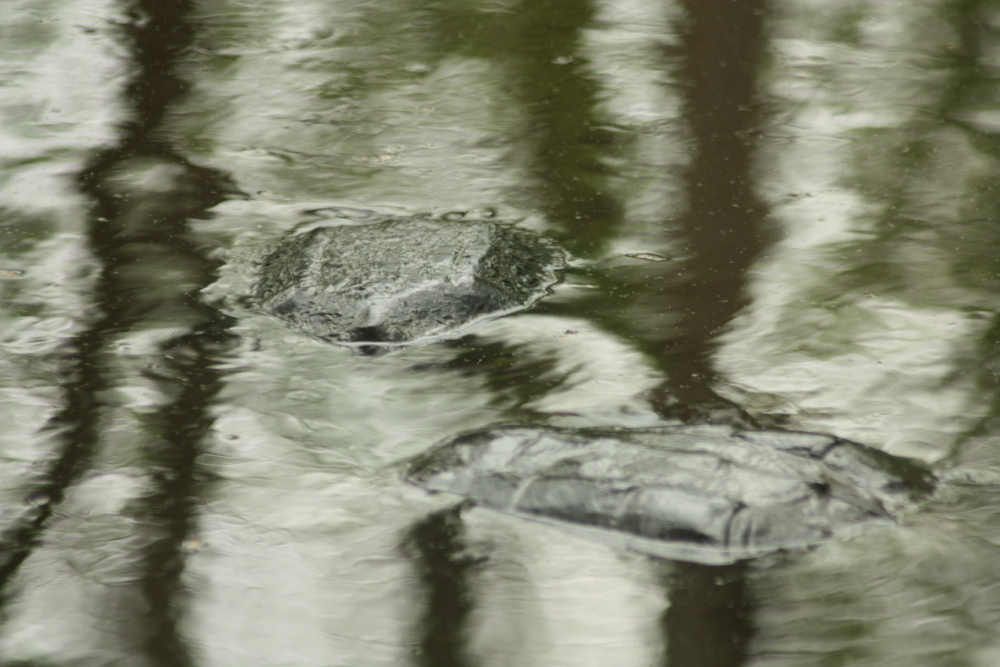
And there was one very cool thing that we was in the Atlantic Ocean.  Again, thanks to Johnny, I got this very distant, very blurry shot of an animal I could potentially never see again...


Can you tell what it is?

How about if I zoom in?
Green Sea Turtle [007-2013]

It's the flipper from a Green Sea Turtle.  Well, probably a Green.  It was a Green that we saw later that night, but there are something like 5 species of Giant Sea Turtles that breed near Tortugero.


I did get a better chance to see a Sea Turtle, but unfortunately I wasn't able to take pictures at the time.

Tortugero, which means 'turtle' in Spanish, is the home to the Sea Turtle Conservancy.  When we got into Tortugero on Tuesday we did cross the river to see the center and watch a movie on the efforts to save the endangered population.  However, the rain prevented us from doing much of anything else while we were over there.  What we were able to do when we got back to the hotel was to sign up for a Sea Turtle Spawning Observation Tour the next night.  So I paid the fee, dressed all in black, like they told us to, and in the middle of the night, with another storm coming in, we hiked down to a restricted section of beach with the local guides.

Once we were in small groups we stood an waited for the spotters. The spotters simply walked up and down the beach, in the dark, waiting for the female turtles to come up on land and start digging their nests.  Once one was sighted, they radioed to the leaders of the groups and we were brought down one group at a time to watch an endangered Sea Turtle lay her eggs.

Now, if you've ever seen any nature specials about how turtles lay eggs, you know that they dig a big hole in the ground, sit over it, let the tough leathery eggs drop into the hole and then cover the hole up with sand and go back into the ocean.  So I couldn't imagine we'd see much.

But then we were called down and they explained that the female turtle is using every single bit of energy and concentration to lay her eggs, so people really don't bother her if they don't get around to where she can see them.

When we got down to where our spotter found one, I realized that we were going to be within touching distance.  The spotter was laying on his stomach, holding the turtle's back flipper up out of the way, shinning a red light into the nest.  Now either she didn't know or she didn't care, because she was busy dropping eggs as we came in.  Because I was one of the shortest people in the group I ended up right in front, kneeling down, not two feet from the edge of her nest.  We'd been told she'd lay about 125 eggs that night.  From what I could see when we got there, she'd only dropped about 15 before we got there and as we watched she must have laid another 15 or so.  Which meant she was going to be there a long, long time.  And apparently each female comes back to lay eggs about 5 times in a season, each clutch getting smaller and smaller.  Most turtles don't start laying eggs until early July, and it was late June when we got there, so the guides were pretty sure that she was laying her first clutch of the year.

It was a pretty amazing experience to see her laying her eggs from so close, but like I mentioned, there was a storm coming in.  We could see the starts when we got there, but as we waited for the spotters to call up, it was like the stars were going out a few at time moving in from over the ocean.  Mama turtle was still laying eggs when we started seeing rather a lot of lightning over the water and started feeling the first few drops of rain.  So we couldn't stay to watch her cover the eggs or go back into the ocean.

I was told that even if it rained really hard, there was no danger to the eggs because they'd either be covered by mom's body or by sand before the water could get in enough to do any damage or wash them away.

It really was an amazing experience.  My next trip needs to be planned for a time when the eggs would be hatching so I can watch the little guys (and girls) scamper for the water en masse!

Friday, January 4, 2013

Stump Pass - 10.08.12 - Post 4

It's Gopher Tortoise Day!  Actually, even cooler than that, it's baby Gopher Tortoise Day!

So this is a baby Gopher Tortoise.  You can tell by how small he looks even next to some blades of grass, but also by the amount of yellow in his shell.


Here you can see him against leaves and sticks in his habitat.  He's very wee!

You can see the sand on his back.  I've never seen the phrase "obligate burrower" before I started looking these guys up.  I know "obligate carnivore" from owning ferrets, but I've never seen "obligate burrowers".  But it's a good thing they are so driven to make their own holes.  Scientists have documented over 360 different species - everything from snakes to owls to armadillos will occupy an abandoned gopher tortoise burrow.

Here's a more grown up guy.  Actually, probably a grown up girl.  Though not a perfect science, most of the boys have a bony protrusion under their chin, jutting out from their shell.  Females don't have that and I don't see it on this one.

She does look like she's doing her tortoise best to say cheese for the camera.  Those are some bizarre teeth!


Sunday, April 29, 2012

Fullersburg Woods Forest Preserve - 4.15.12 - Post 2

So here we go with the first set of spottings from Fullersburg...

White-Breasted Nuthatch (025 - 2012)

Here's my one new bird for the walk.  I saw a lot of birds, got some good shots, but I think this was the only one that was brand new for me.

This is a White-Breasted Nuthatch.
Nuthatches and creepers are really similar birds in both shape and behavior.  The easiest way to tell them apart - mostly - is by watching them on the trees.  Creepers will *always* go head down and around in a circle.  Nuthatches will travel in any direction, their heads going the way they're going.

So, of course, I happen to catch a nuthatch that's going down the tree, head-down.  Which led to me researching creepers for far too long before I realized it wasn't one.  *sigh*

Virginia Bluebells (026 - 2012)
 I didn't realize we had wild bluebells in Illinois.  I think I've mentioned before that I love seeing blue in nature.

 One of the nice things about Fullerton, besides the indoor chart, is that they have a cultivated area where they've put in a few of each wildflower and a sign that tells you what they are.  I know I've advocated shooting the signs before.  All these shots are from places I found them outside the cultivated area, but it was really nice to get shots of the signs and the planted bits, because it makes identification so much easier when I get home.

So, the rest of this post will be about the Common Snapping Turtles I found courting when I was walking near the river. 

Putting this spotting up at ProjectNoah.org was awesome, as there were some people there who gave me some great information.
Common Snapping Turtles (027 - 2012)
Neil Dazet told me, "Those 3 ridges that you see in the 2nd picture are common in this species, but they tend to smooth out and be less defined in older individuals. Also, female snappers are slightly bigger than male snappers. So it looks like an older male snapper attempting to mate with a younger female."
 Which, just... how awesome is that?  I know which species I've got, which one is which gender and their relative ages!  So cool!
 They were in the water the whole time and most of the time (and I was watching for about 15 or 20 minutes), they were 'hugging' - carapace to carapace with their legs holding on to each other - most of the time.

 During this time, I saw more soft parts of turtles (no, not like that!  Well, not that *I* could recognize anyway) than I ever have before.


They were so unconcerned with me that I was even able to sit and take some video of them.


 So you can start to see why my accidental walkabout (due to the broken bridge) wasn't the worst thing that's ever happened to me. :)  More animals tomorrow!


Total Identified Species Sited for the Year: 27
Total Unidentified Species Sited for the Year: 1
Total New Species: 14

White-Breasted Nuthatch*
Virginia Bluebells*
Common Snapping Turtles*

Monday, June 6, 2011

Lincoln Park Ponds, more new species - May 31, 2011

Wow, haven't posted in almost two weeks.  Sorry about that.  It's not that I haven't been out shooting, I just haven't had time to get a post together.

That and the fact that I'm completely obsessed with ProjectNoah.com.  It's a fantastic site to talk to people who do a lot of what I do here.

Anyway, on Memorial Day, May 31, I hiked all three ponds on one of the very first 90 degree (F) we had this year.  The weather has been very slow to warm up which has kept the cold-bloodeds in hiding for a long, long time.  They're *just* making their way out now, as the migratory birds (the warblers and some of the finches, etc...) make their way up and out of the city.

Sign of Summer
 One of my favorite signs of summer.  The dragonflies are back!  We don't have the clouds of them (okay, that may be a bit of an exaggeration) that we had around this time last year, but slowly but surely, a few species are parking themselves somewhere easy to photograph.
Bowing Carolina


  I'll need to go back and check my posts from last year, but I think I was identifying all the bright red dragonflies like this as Red Saddlebags, but while checking this a few dozen times before putting it up on Project Noah (I *love* that people there will correct you if you get a spotting wrong, but I'd prefer to get it right myself the first time if I can.)  Anyway, it turns out that this is, in fact, a Carolina Saddlebags.  You can tell because a Red has these clear patches on their wings right where they attach to the body.  This one is red to the abdomen, so it's a Carolina.  Another tell is that the last couple segments on the Carolina are dark brown or black.  They're the same red as the rest of the tail on the Red Saddlebags.

First Spotting of a Twelve Spotted
 Like last year, one of the first dragonflies and easiest to identify is the Twelve-Spotted Skimmer.  This guy would perch for about eight seconds, I'd get a few shots and then he'd fly off in about a ten foot radius circle and then come right back to this stick and perch again before starting the process all over.  Made it easy to shoot him.  I just had to wait a few seconds everytime he left, since I could depend on him to come back. :)

Red Ears with Their Eyes on Me
 Another one I've learned better about.  Last year I thought all the turtles in the North Pond were Red-Eared Sliders. Turns out a lot of them were Eastern Painted.  So when I learned that, I started thinking that maybe I was just getting them all wrong and they were all Painteds.  But no.  Here are some honest-to-goodness Red-Ears.  In this case you have a male (the smaller) and the female (the larger).
A Bee on a Bud


The bees are making their way out too.  Here's a honey bee checking out the early goldenrod.


And about the time the bees come out, the wasps come with them.  Clearly my "this can puncture me and I should flee" instinct didn't recover over the winter.  I'm still trying to figure out which kind of wasp he is.  Any ideas?

Okay, so this guy clearly isn't cold-blooded, but I was really chuffed over this sequence of shots I got of him coming in for a landing.


I would have loved for that last shot to have been a little clearer, but he landed pretty far back. It's still a fun series of shots, though.  Night Herons are about as exotic as we get out here.

The Carolina Saddlebag and the Red-Eared Sliders (properly identified) are my only new species for this post, but that brings my total up to 35 of my 50 new species.


Wednesday, May 18, 2011

Last New Species post for North Pond - 5.10.10

So I thought I was done with new species for this trip, but then I started going through the shots I'd oh-so-cleverly labeled things like "CheckThisBird" and "UnknownSparrow".

 The first thing I found was this dragonfly wheel.  Unlike the pondhawks I had a ton of last year, this is apparently a Common Green Darner.  He's different because instead of having a solid, dusty, light blue tail, he has a darker green tail with brown marks on it.  He's also *huge*.
 After a few hundred painted turtles, I finally found something a little different.  This is apparently a False Map Turtle.  According to Wikipedia, When with other turtles, they also are very communal, sharing space and using each other for predator watching, increasing the odds of surviving an attack by any unwanted animal. Which explains why every time I saw one of these, they were hanging out with the bigger, more obvious, painted turtles. :)

Like this:

 A False Map hanging out with a group of Sliders.
 Not a new species, but in case you haven't noticed, I find sexual dimorphism fascinating.  This is the female Common Yellow-throat Warbler.
 The folks at the fabulous Project Noah site had to help me with this one.  Turns out he's a Lincoln's Sparrow.  They migrate through Chicago, but apparently don't stay.  So I was lucky to catch him as he passed through town.
 Here you can see his identifying head stripes a little bit better.
 This one is still throwing us for a loop at Project Noah.  He's a wren.  We know that much.  The white eyestripe makes me think he's a Carolina Wren.  But the Carolina Wrens have a very white chin, and this guy doesn't seem to have that.  The Marsh Wren is similar in coloring, but doesn't have the white eyestripe.  Any suggestions gratefully accepted! :)
 Another view, in case it helps. :)

 Something else that needs an I.D.  It's a beetle.  It was digging around in the bark chips on the path of the North Pond.  Any ideas?


Okay, so, I'm not entirely sure what they all *are*, but there's five new species in this post.  So now I'm at 28 of my 50, and the butterflies and dragonflies and most of the cold-bloodeds haven't really started making an appearance yet.  I may have to up my goal. :)

Friday, July 16, 2010

North Pond - July 14, 2010 - Post #2

Okay, here we go again. More shots from that same walk I was talking about yesterday.


A purple coneflower. More fun with macro mode. [Coneflower Near the End of the Road]


I'm learning to do a lot more with manual focus. For example, I wanted to focus on this grackle with a seed in his beak, but my camera kept insisting on focusing on the green leaf in front of him. It's trickier to get a shot quickly, but if your subject is sitting still for a minute, you do get a much better shot.

[Grackle with Seed]

This guy was adorable. He came creeping down from a higher branch and seemed pretty shocked to see me standing right under his nose. But instead of running back up the tree, he just flattened himself against the branch like, "You can't see me. I'm blending in!" Too bad the tree was mostly green from lichen. :)
[Flat Squirrelly]

Peekaboo turtle! Don't let fables fool you. Turtles - at least Chicago turtles - are pretty fast. This guy would hear my shutter, duck back under water swim a few yards, pop back up. I'd catch him, he'd duck under and come back up somewhere else. Very, very quickly. I love that you can see his feet and shell under the water in the breaks in the algae. [Peekaboo Turtle]

Near as I can Google, this is an upside down Carpenter Bee. I think the flower he's on is some kind of onion variety. Anyone know?

[Carpenter Bee]


Most adorable shot ever! The "Rainbow Duck" shot from yesterday is mom. She was swimming around this log while her babies sat up high and dried and preened and rested. I still need to look up what kind of ducks they are.

[Ducklings on a Fallen Log]


I love this as an artistic shot. I also love that my Google-fu found that this plant is called Blue Vervain and that the bee is a female bumblebee. This is the kind of shot that I end up filing away for the next Art Sharks or contest I find.

[Bumblebee and Blue Vervain]


So, truthfully, the smaller you make this shot, the better it looks. :p He took off, I held down my shutter and just followed him as he went. The good news is, the camera did know what I was focusing on (as evidenced by the almost invisible, yet still visible enough to be annoying tree branches in the foreground), the bad news is, there's a lot of blur when trying to catch a heron that's diving for its dinner. [Heron Goes Dinner Diving]

He's so much easier to catch well when he's sitting still. :)

[Juvenile Great Blue Heron Watches the Horizon]


And here he is in all his glory. And in context. I think I may have inadvertently focused on his chest because it's a little more in focus than his head. But given the distance I was at when I took this, I'm surprised it came out as well as it did (even if I did have to darken it a bit in Graphic Converter). I love how you can see the darker feathers coming in on his chest and in his tail. And a little detail? Look at the zig-zag reflection of the grasses in the water. [Young Heron in the Grass]


Okay, ten pictures make a post. Let me know what you think. :)