Showing posts with label south pond. Show all posts

Monday, June 6, 2011

Lincoln Park Ponds, more new species - May 31, 2011

Wow, haven't posted in almost two weeks.  Sorry about that.  It's not that I haven't been out shooting, I just haven't had time to get a post together.

That and the fact that I'm completely obsessed with ProjectNoah.com.  It's a fantastic site to talk to people who do a lot of what I do here.

Anyway, on Memorial Day, May 31, I hiked all three ponds on one of the very first 90 degree (F) we had this year.  The weather has been very slow to warm up which has kept the cold-bloodeds in hiding for a long, long time.  They're *just* making their way out now, as the migratory birds (the warblers and some of the finches, etc...) make their way up and out of the city.

Sign of Summer
 One of my favorite signs of summer.  The dragonflies are back!  We don't have the clouds of them (okay, that may be a bit of an exaggeration) that we had around this time last year, but slowly but surely, a few species are parking themselves somewhere easy to photograph.
Bowing Carolina


  I'll need to go back and check my posts from last year, but I think I was identifying all the bright red dragonflies like this as Red Saddlebags, but while checking this a few dozen times before putting it up on Project Noah (I *love* that people there will correct you if you get a spotting wrong, but I'd prefer to get it right myself the first time if I can.)  Anyway, it turns out that this is, in fact, a Carolina Saddlebags.  You can tell because a Red has these clear patches on their wings right where they attach to the body.  This one is red to the abdomen, so it's a Carolina.  Another tell is that the last couple segments on the Carolina are dark brown or black.  They're the same red as the rest of the tail on the Red Saddlebags.

First Spotting of a Twelve Spotted
 Like last year, one of the first dragonflies and easiest to identify is the Twelve-Spotted Skimmer.  This guy would perch for about eight seconds, I'd get a few shots and then he'd fly off in about a ten foot radius circle and then come right back to this stick and perch again before starting the process all over.  Made it easy to shoot him.  I just had to wait a few seconds everytime he left, since I could depend on him to come back. :)

Red Ears with Their Eyes on Me
 Another one I've learned better about.  Last year I thought all the turtles in the North Pond were Red-Eared Sliders. Turns out a lot of them were Eastern Painted.  So when I learned that, I started thinking that maybe I was just getting them all wrong and they were all Painteds.  But no.  Here are some honest-to-goodness Red-Ears.  In this case you have a male (the smaller) and the female (the larger).
A Bee on a Bud


The bees are making their way out too.  Here's a honey bee checking out the early goldenrod.


And about the time the bees come out, the wasps come with them.  Clearly my "this can puncture me and I should flee" instinct didn't recover over the winter.  I'm still trying to figure out which kind of wasp he is.  Any ideas?

Okay, so this guy clearly isn't cold-blooded, but I was really chuffed over this sequence of shots I got of him coming in for a landing.


I would have loved for that last shot to have been a little clearer, but he landed pretty far back. It's still a fun series of shots, though.  Night Herons are about as exotic as we get out here.

The Carolina Saddlebag and the Red-Eared Sliders (properly identified) are my only new species for this post, but that brings my total up to 35 of my 50 new species.


Friday, May 20, 2011

Apparently this is the Spring of Me Rescuing Birds

So, last month there was the grebe that crash landed in the middle of a Chicago street that I rescued and got to a wildlife sanctuary where it was given medical treatment and rehabilitated.

Then this week there were the baby geese that were stuck behind the chicken wire.

So I'm chasing this little bird around (the guy on the fence post, not the geese in the background) when I notice... hey there's a pair of geese in the background!  And at this time of year, where there's a pair of geese, there's frequently baby geese.

And sure enough.  These particular parents had a set of triplets. Aren't they adorable?


But then I notice that this one is behind the chicken wire fence.  Now I know most of the chicken wire fence around the South Pond is to keep people on the paths and off the plants.  But right here, there's a goofy comma shaped section closed in between the path and the pond.

Two of the goslings had gotten into that comma shaped area.  Momma, Poppa and one of the babies were on the outside of it, with a clear path down to the water.

The ones to the right of the fence... I don't even know how they got in there.  About two feet across, at the back of the section, the fence is underwater.  I couldn't find a gap anywhere that would explain how birds that can't fly yet got into this space.

At this point I stopped taking pictures, in fact, I set all my gear down to figure out how to get all the geese back together.  Unlike a mother mammal, geese don't have the instinct to 'scruff' their young and move them.  All they can do is herd them and trust the small one's instinct to stay close to the parents.

In this case that was actively working against them.  As I got close the parents crowded up against the fence and began to hiss at me.  They never honked and they never flapped at me or tried to charge me. And believe me, Chicago geese are afraid of *nothing*.  Certainly not people.  I have to think they understood I was trying to help.

For about half an hour I tried to lift the fence (it was nailed down too well) or find the opening they'd used to get back there in the first place (I still don't know how they managed it.)  But when the goslings tried, repeatedly, to shove themselves through the chicken wire to get back to their parents, I knew I needed to do something.  They could get their heads and necks through the holes, but clearly couldn't get their tubby little behinds through a roughly one-inch diameter hole and they'd thrash when they got their heads stuck.

So I stepped over the fence, to the parents' great displeasure, and herded the goslings up to a corner of the space they were stuck in and one at a time picked them up and put them back down, right in front of mama.

Now, I know some people hold on to the old wives' tale that if you handle a baby bird, the parents will smell 'human' on it and reject it.  I've done enough reading to know, a bird's sense of smell is garbage and their need to take care of their young is very, very strong.  In my reading about song birds falling out of the nest, they said to pick it up and put it back in the nest if you can.  So in this case, picking them up for the three seconds it would take to get them back where they could rejoin their families was certainly not going to be an issue.

So I did.  I got them back over the fence...
... where Momma and Poppa herded everyone together and back down to the water...
Where they set off for the island in the pond where there's none of that pesky chicken wire to separate them.

So that puts my bird rescue total for the season at three.  Wonder what it'll be by the fall? :)

Friday, September 10, 2010

South Pond - 8.30.10 - Post 5

Okay, wrapping up that last August walk.  Just a few more shots...

Seven of Swords
 Another Blue Vervain shot.  I'm really taken with the little clusters of flowers that aren't quite on the tip of the stem and the way the long stems are separate from each other, instead of clustered together like they would be on a Bull Thistle or something..
A Dash of Blue


Another Familiar Bluet.  This thing is perched on the edge of a fragile, dying leaf.  It's so small and so light that the leaf doesn't move at all when the damselfly takes off or lands on it.
Neon Damselfly Glows from the Inside


 Here he is close up.  He's almost neon the way he seems to glow against the gray algaed background.  You can even see his little tiny feet hanging onto the light edge of the leaf.  His wings are so transparent you can see the segments and black stripes right through them.
I'm Pretty Sure Your Nose Is Longer


Fiery Skipper drinking from a (I think) purple milkweed flower.  Check out the proboscis.
Skipper with a Drinking Habit


Here she flipped to give me a side view - you can still see the proboscis - but now you can see those prominent front legs.
Buckeye: Inverted


Buckeyes have a weird habit of hanging out upside down.  I don't know if I've posted about this before, but I know it's not the first time I've seen an inverted Buckeye.  I don't know if it puts those big fake eyes at the top - fooling any predators that might come along - or what.


Okay, next up - Volo Bog.  A very interesting place to shoot.  Too bad I did it in hurricane force winds!

Tuesday, September 7, 2010

South Pond - 8.30.10 - Post 3 (The Very Hungry Caterpillar Gets a Very Stripey Friend)

Okay, yesterday I posted a huge batch of pictures of a monarch caterpillar.  Well, while I was planted on the boardwalk snapping away, a wasp came over and joined Claude.  (We'll call him Claude.  'A monarch caterpillar' gets a little old after a while, and after all, I've gone on about him for two days, so he deserves a name. :)

Claude and a Wasp

Here's Claude and his friend the wasp.  The wasp is drinking from the flowers... Claude is eating the thing whole.  I'm really thrilled with how clear this little wasp came out.  You can see how he's using his antennae to hold himself still and his bright green eyes are mesmerizing.


The Wasp Sees Claude

In this one you can see in the space between the wasp's eyes.  And you can see Claude twisting to work on that slightly raggedy flower.  You can see the stem left from the flower he was eating in yesterday's post just to the left of Claude's antennae.  You can see the black splotch on his back in this one.


Parallel Stripes

This may be the best shot of the two of them.  The wasp came in ridiculously clear.  This is the shot that let me identify him as a sand wasp.  Which explains why he was so content to be so close to the ground.
Parenthetical Insects


This one gives the effect of a set of parenthesis turned 90 degrees. 


A Closer Inspection

Here the wasp comes down to check out Claude.  Claude seems way more interested in sucking down that milkweed flower.

Wasp Eyes on the Photographer (Claude Doesn't Care)

Now the wasp is looking at me.  I mentioned a few posts back that I need to become re-afraid of things that can puncture me.  Apparently this was not that day.
Friends Come in Every Stripe


 I have to say that I did love that Claude and the wasp had the same colors and are both stripes.  It makes the visual effect simpler and, I think, more striking.  There's probably a joke about them calling each other to coordinate their outfits that day. :)


Okay, I'm still not done with the day's hike, but I think I may be done with Claude.  He was an awesome 'portrait model' though, and I wish him well in his butterflying days ahead.

Monday, September 6, 2010

South Pond - 8.30.10 - Post 2 (The Very Hungry Caterpillar)

Americans (at least) of a Certain Age were raised on children's books by Eric Carle.  One of my favorites was always The Very Hungry Caterpillar, which was written in 1969 (so it's just a bit older than I am. ;) and while on this walk, I finally got to meet The Very Hungry Caterpillar. :)

I had been thinking just before went out that day that I'd seen so many varieties of butterflies this summer, but I hadn't seen even one caterpillar. I was sure part of it was that butterflies *grab* your attention.  When something flies across your field of vision, you follow it. Caterpillars inch along slowly and hope to not be seen, since they can't exactly bolt if they're detected by someone who wants to eat them.  So I made a mental note to look harder.  And sure enough... big, beautiful monarch caterpillar on my very next walk.  Even more fortunate, he was busily munching away on a milkweed plant that had sprung up between the boardwalk and the fence, so I was able to sit (and when necessary, lay) on the boardwalk and shoot from any angle I wanted to without anything between us blocking my view.

Monarch Caterpillar Munches Milkweed
Here he is, looking right at me.  Well, I think he is.  His eyes aren't exactly well-defined.  His antennae were amazing to watch as they wiggled and probed and twisted.  You can see here that he's munching away on the milkweed flowers.


One Petal at a Time
You can sort of see it at this size, but if you enlarge this one it's a lot easier to see; he's holding the flower petal with his front feet as he eats it.
"Bite Size" is Subjective


So much of the detail in these shots is lost when I scale them down.  In this one, you can see where he's taken a bite out of the flower petal right in front of his 'nose'.
Redefining 'Plant Food'


Here he's holding himself up with his front feet as he continues to work on the flower.  He's actually caught the flower and pulled it down to him to make eating easier.
All You Can Eat Milkweed Buffet


Here he is in context.  I love how you can see the difference between the slim front feet he'll keep as a butterfly and the stocky, blocky back feet that he needs to move his little caterpillar butt along with his front.  Again, great views of his antennae.


Petal Power
Here's a closer version from that same sequence of shots.  (You can tell it isn't the exact same shot with a different crop by his antennae positions.)

No, You Can't Have Any
Here he's coming straight at me with his antennae out like the ears of a dog.

So Many Flowers, So Little Time...

I pulled back and shot with my kit lens for a few minutes to give a greater depth of focus.  I can just hear him thinking, "So many flowers, so little time..."
Flower Powered


Here he is coming at me again, still working on that flower he'd pulled down.
*burp*  All gone.


But this is my all time favorite of him alone.  He's eaten the whole flower.  You can see the stem still on the plant.  And in his four front feet he's holding the very last bit of the flower as he chows down.  This shot, more than any other I took, makes me think of the caterpillar from "Alice in Wonderland".  I think it's the pose.


Now I need to keep an eye out for a chrysalis.  I know it's getting to the end of the season, but hey, they still seem to be procreating, as this guy proves.

Up next, my little buddy here gets a friend.

South Pond - 8.30.10 - Post 1

I feel the need to preface this post with the surrounding details.  I went to run a few errands in Lincoln Park, and it ended up being a bust - the things I needed to pick up weren't done.  So I walked the South Pond since I was there anyway.  When I got home I found that my little ferret, Magick, was in the process of passing away.  She was almost 8 years old - which is quite old for a ferret - and she'd had cancer for a year, so this wasn't unexpected.  However, even when expected, losing a beloved pet sucks rocks.  And while I am absolutely certain that me not taking this walk wouldn't have changed things for her, there's still a little bit of me that says, "Damn, I should have gone straight home."  You know?

So, I'll miss the little muppet.

Magick - January 1, 2003 - August 30, 2010

Anyway... this is what I saw while I was out.

Great Black Wasp on Bubbles
This is a Great Black Wasp.  Buried in the algae he's walking on just above his head is a skipper butterfly who apparently got sucked in.  What I was really interested in here was the bubbled surface of the pond algae that the bug is walking on.
Fiery Skipper on Marsh Thistle


 Fiery Skippers are having a great year at the South Pond.  There are hundreds of them.  Here's one on a Marsh Thistle.  At least I'm pretty sure it's Marsh Thistle.  It's next to the pond, but the maps I find usually say that the southern edge of the plant's range is southern Wisconsin.  Though, you know, Chicago isn't a ridiculous distance from southern Wisconsin, so it's not unreasonable that the park folks would choose to install it here.  ANYWAY... if you click on the picture to make it bigger, you can see the butterfly's proboscis as he feeds from the flower.

Argiope on Railing
I wish this guy had sat still just a little bit longer.  He's roughly half a cm from front foot to back end.  Really, really tiny.  And pretty hyper.  If you can't tell what he's on, it's the railing to the pond boardwalk.  I almost discovered him the hard way as I trailed my hand along the metal.  I think it's an Argiope - also called a Yellow Garden Spider.  I'll need to keep an eye out to see if I can get a better shot of one next time I'm out there.

I'm Ready for My Close Up
There was a gigantic flock of sparrows hanging out between the zoo gate and the part of the pond closest to the zoo.  If you got too close they came up off the ground and into a tree, but if you waited a minute, they'd all head back for the ground under the boardwalk.  I think it's a song sparrow (seriously, until I started looking, I had no idea how many kinds of sparrows there are out there.).  Anyway, I loved the way he turned his head up to look at me as if trying to decide if I was enough of a threat to bother him into moving.

Pondhawk on Broadleaf

An Eastern Pondhawk Dragonfly on a leaf over that same patch of bubbly algae.  I was playing with the bokeh a little.  I wanted an angle where I wouldn't get that dead leaf under the dragonfly's leaf, but my mobility was kind of limited on the boardwalk.  Still, I think the dragonfly pops out.


Upside-Down Tachnid
 I was ridiculously pleased with these shots of a Tachnid Fly on a Rattlesnake Master.  I mean, sure, it's a fly, but as pictures of flies go, I like these. :)
Rightside-Up Tachinid


Look how prominent his antennae look against the plant.  You can also see how he's holding on with all of his feet.

Fl-eye

His eyes are so pronounced in this shot.  He's not looking at me head-on, but your eyes still go straight to his red ones.

Cuckoo in the Rattlesnake Master

Same kind of plant, different kind of bug.  Google tells me this is a Cuckoo Bumblebee.  And if you read up on these things, they're nasty!  They infiltrate hives of other bees and take over.

Fire Colored Beetle on Rattlesnake Master
Obviously the Rattlesnake Master was the plant of the day.  Here's a Fire Colored Beetle (something new :).  I was captivated by his antennae which never stopped moving.
Eye Catching Monarch


Monarchs, Monarchs everywhere.  I'm starting to see more Monarchs in Chicago.  I don't think I've taken a walk all summer where I haven't found at least one.  This shot is fun because it has this great 3D effect where the butterfly and the branch it's perched on seem to stick out from the leaves in the background.
Milkweed Unmunched


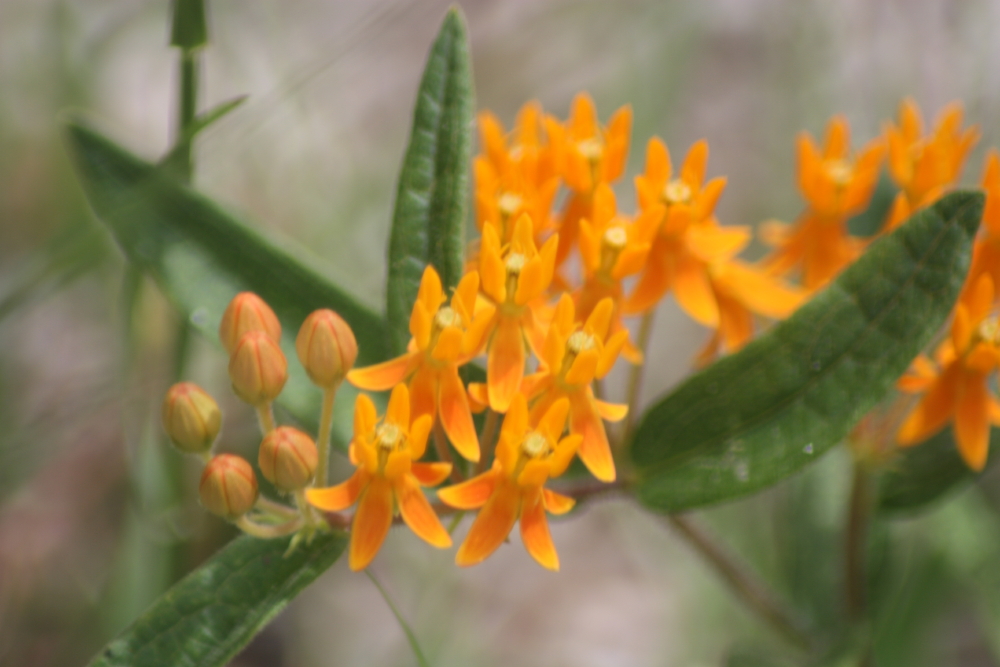
This is Butterfly Milkweed.  Not only are they a beautiful, bright flower, they attract the Brushfoot Butterflies and their larva.  This will be key in the next post. ;)


Up next... the amazing shots of the first caterpillar I found all year.  Go figure it was almost September before I could find one!