Showing posts with label heron. Show all posts

Sunday, January 6, 2013

Stump Pass - 10.08.12 - Post 5

Today I have a heron.  It's a Great Blue Heron.  They come up north in the summer, but even then are pretty rare.

Here's one standing on a sign in the bay.


But this is the shot I really like.  He's up in his nest.
Really, really UP in his nest!

Tuesday, May 1, 2012

Fullersburg Woods Forest Preserve - 4.15.12 - Post 4

Here we go again! :)  More Fullersburg Woods spottings.

One of the real stories of the day was the sheer flocks of Red Admiral butterflies.  I mean, I could stand on the path and look at some of the nearby flowers and there would be six or seven of these guys floating around.  I'd walk 20 feet down the path, look at some flowers and see six or seven more.  And the whole place was like that.

Red Admiral Butterfly (035 - 2012)
Red Admirals aren't uncommon in the area, but we tend to get a lot more Monarchs and Painted Ladies and smaller butterflies in the Whites and Sulphur families.  So the large number of these guys was notable.  And they aren't just hanging out in forest preserves - which is the only places I've seen them before - they're around the block I live on!  I've seen them in really busy Chicago neighborhoods.  The news is even covering the abundance of these guys, there's so many.
Now one of the nicer things about being in 'the middle of nowhere' in the middle of Northern Illinois, is that I can still get cell phone reception out there.  So I googled Red Admiral caterpillars, to know what I was looking for, but even then I didn't see any. :(  I'll keep looking though.

There were also herds of little white butterflies that didn't, from what I could see, have the black spot that marks a Cabbage White.  But not one of them would land for more than half a second.  Not one.  So maybe if I go back out there next month I'll have better luck with those.

This is another flower that was tricky to research.  Turns out it's a Wild Geranium.  It's about an inch across, so it's a pretty small flower. 
Wild Geranium (036 - 2012)


I love the clarity of this shot.  The clear dark veins in the petals, the anthers that are bright yellow with pollen.


Great Black Wasp (037 - 2012)

The bees and wasps are slowly making their way out.  This Great Black Wasp was hanging out near the Red Admiral Butterflies


I need to start working on using a fill flash when I'm outside just to let the camera move a little faster.  This could have bee a really cool shot if the ISO were lower and the shutter was a bit faster.  You can see the hairs on the wasp's feet, but where his wings were moving a bit and his antennae were clearly moving, there's too much blur.
 And this is where I wish I had my tripod.  This Great Blue Heron was just hanging out on this downed tree on the other side of the river for a very, very long time.

I would have loved to have been able to use a narrower aperture to get this guy, because clearly there's too much light here and there's still blur, which means the shutter was open too long to be done well hand-held.

The heron was itching and moving and ducking around to stretch as I was watching.  Here you can see the length of his neck, even if it is all folded up under his head.
Great Blue Heron (038 - 2012)


Here you can see him scratching an itch on his head.  It made his white crown pop up.

On a photography note, you can really tell the difference between the shooting modes I was using.  In the first two I was on 'action' mode and let the camera make the decisions for me.  It chose f5.6 at 1/200th of a second.  It also clearly changed the setting of the white balance and it upped the ISO to 200.

On this one, you can see that it looks much greener.  This was done on Av (aperture priority mode, meaning I set the ISO, the white balance and the f-stop, the camera chose the shutter speed).  I had it on ISO 100, the white balance was set for a cloudy day and the f-stop was 5.6 here also.  The shutter speed was a much slower 1/50th.  You can clearly see what the difference is between the two white-balance settings.  The first one has a lot more blue and this one is a lot more yellow.  Honestly, I think the true light values were somewhere in between.

Okay, one more post on this walk then I need to double back around and do the North Pond walk that I actually did between the last Magic Hedge trip and this trip.

Total Identified Species Sited for the Year: 38
Total Unidentified Species Sited for the Year: 1
Total New Species: 20

Red Admiral Butterfly
Wild Geranium*
Great Black Wasp
Great Blue Heron

Monday, June 6, 2011

Lincoln Park Ponds, more new species - May 31, 2011

Wow, haven't posted in almost two weeks.  Sorry about that.  It's not that I haven't been out shooting, I just haven't had time to get a post together.

That and the fact that I'm completely obsessed with ProjectNoah.com.  It's a fantastic site to talk to people who do a lot of what I do here.

Anyway, on Memorial Day, May 31, I hiked all three ponds on one of the very first 90 degree (F) we had this year.  The weather has been very slow to warm up which has kept the cold-bloodeds in hiding for a long, long time.  They're *just* making their way out now, as the migratory birds (the warblers and some of the finches, etc...) make their way up and out of the city.

Sign of Summer
 One of my favorite signs of summer.  The dragonflies are back!  We don't have the clouds of them (okay, that may be a bit of an exaggeration) that we had around this time last year, but slowly but surely, a few species are parking themselves somewhere easy to photograph.
Bowing Carolina


  I'll need to go back and check my posts from last year, but I think I was identifying all the bright red dragonflies like this as Red Saddlebags, but while checking this a few dozen times before putting it up on Project Noah (I *love* that people there will correct you if you get a spotting wrong, but I'd prefer to get it right myself the first time if I can.)  Anyway, it turns out that this is, in fact, a Carolina Saddlebags.  You can tell because a Red has these clear patches on their wings right where they attach to the body.  This one is red to the abdomen, so it's a Carolina.  Another tell is that the last couple segments on the Carolina are dark brown or black.  They're the same red as the rest of the tail on the Red Saddlebags.

First Spotting of a Twelve Spotted
 Like last year, one of the first dragonflies and easiest to identify is the Twelve-Spotted Skimmer.  This guy would perch for about eight seconds, I'd get a few shots and then he'd fly off in about a ten foot radius circle and then come right back to this stick and perch again before starting the process all over.  Made it easy to shoot him.  I just had to wait a few seconds everytime he left, since I could depend on him to come back. :)

Red Ears with Their Eyes on Me
 Another one I've learned better about.  Last year I thought all the turtles in the North Pond were Red-Eared Sliders. Turns out a lot of them were Eastern Painted.  So when I learned that, I started thinking that maybe I was just getting them all wrong and they were all Painteds.  But no.  Here are some honest-to-goodness Red-Ears.  In this case you have a male (the smaller) and the female (the larger).
A Bee on a Bud


The bees are making their way out too.  Here's a honey bee checking out the early goldenrod.


And about the time the bees come out, the wasps come with them.  Clearly my "this can puncture me and I should flee" instinct didn't recover over the winter.  I'm still trying to figure out which kind of wasp he is.  Any ideas?

Okay, so this guy clearly isn't cold-blooded, but I was really chuffed over this sequence of shots I got of him coming in for a landing.


I would have loved for that last shot to have been a little clearer, but he landed pretty far back. It's still a fun series of shots, though.  Night Herons are about as exotic as we get out here.

The Carolina Saddlebag and the Red-Eared Sliders (properly identified) are my only new species for this post, but that brings my total up to 35 of my 50 new species.


Saturday, October 9, 2010

Rollins Savanna - 9.20.10 - Post 3

And now back to your scheduled programming...

I got distracted there for a few days by finding out that I will, in fact, be able to show in a large local art show, after being initially told that it was sold out.  So now I'm trying to decide which shots to show and what sizes.  If you have a shot you're particularly fond of, or ideas about what makes a photograph commercial, I'd *love* to hear from you!

In the mean time, I was posting about Rollins Savanna...

A Swath of New England Asters
 I love these asters.  For flowers in the fall they were still going strong.  And the way they cut across the frame brings your eyes down and over through the entire shot.

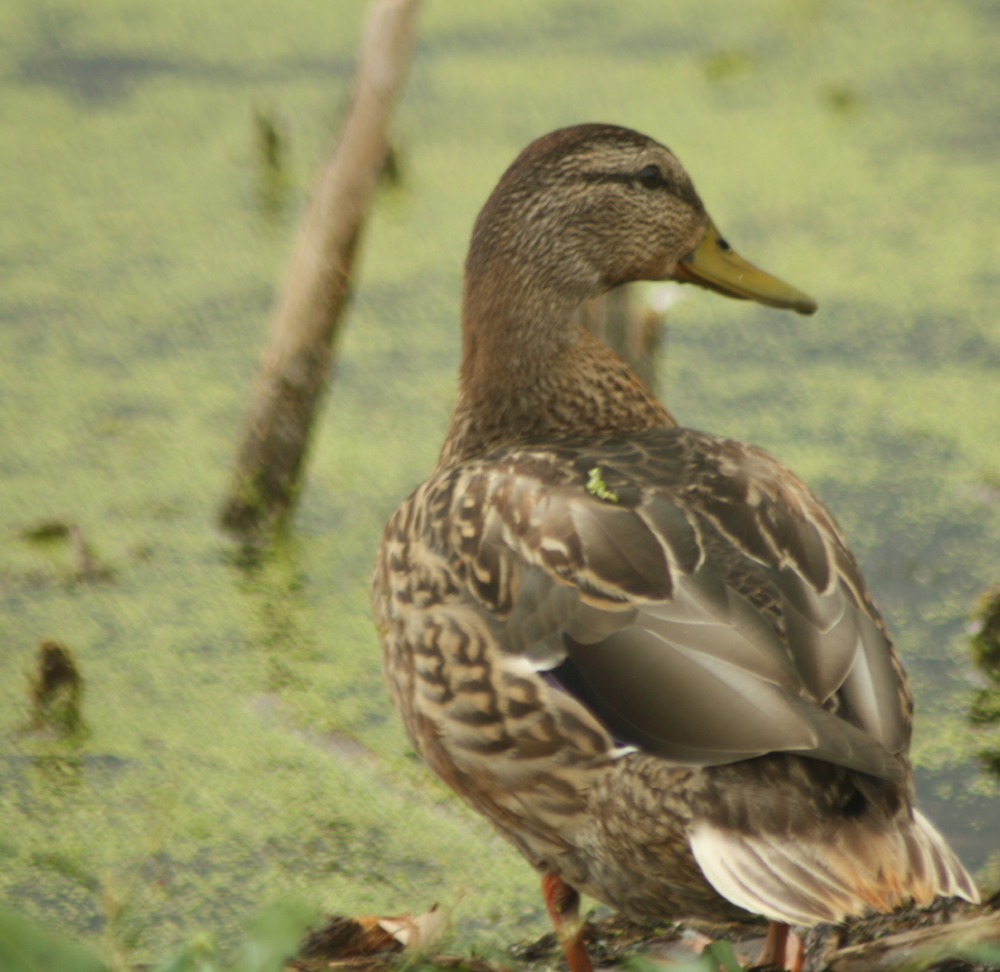
Duck Checks Her Rearview
 The ducks in the three ponds were pretty calm - much calmer than, say, the kildeer. I was able to get up pretty close to this female mallard and then she turned to see what I was up to, which was nice of her. :)
Onto Every Chicory, A Little Rain Must Fall
I'm still quite fond of chicory plants.  I like the jagged edges of the petals and the stark black and white in the center.  As I mentioned back in the first post, it was raining off and on all day, which gave me this beautiful rain splattered flower.


Egret in Flight
 Okay, so getting good shots of birds on the ground or in a tree is still challenge for me, never mind me getting good ones of them in flight.  But this one doesn't suck.  I was even able to crop out the houses he was flying over.
Egret Reflects
 Another egret and reflection.  It was nice of him to stand where there was a patch of un-duckweeded water nearby. ;)
The Frog Remains the Same
 Remember in that other post I mentioned the frog that was sitting by the bridge as I passed by... and was still there, like, two hours later when I came by again?  Here is on my second pass.  I could see him breathing and his eyes are open, so, you know... not dead... but not active either.  On this shot I could see his little froggy toes turned in under his chin.
Tall Heron
 A Great Blue Heron being as tall as he could possibly be on top of a muskrat lodge.
Heart-Shaped Red Admiral
 A Red Admiral on white flowers.    I like that in this shot he's heart-shaped.
Goldenrod and Honeybee
A honeybee on goldenrod.  I can count his stripes. :)


A Pack of Quackers
Like I said, the place was thick with ducks.


Okay, one more post and I'll be done with this trip.  Is it bad that I'm kind of hoping for a week or two of crap weather?  I need some time to catch up!  As it is, it's October in Chicago and it's going to be 80 degrees today and 84 tomorrow.  I think I'm going to need to go out and shoot some more while I can.  Which, you know, is not helping in the "catching up" department.

Saturday, August 21, 2010

South Pond - 8.18.10 - Post 2 (The Birds, the Bees and the Fishies)

Okay, last set of shots from Wednesday, so that I can start going through my shots from today, before I got out again tomorrow.  :)

Wasp on Orange Flowers
A wasp on a flower.  At this size it's a little harder to see, but the stripes on his abdomen are almost green.

I may have mentioned this before, but photography has completely wiped out my sense of self-preservation when it comes to things that could puncture me.  (And that's just so wrong, given my huge phobia of needles and such).  But I no longer go, "Look, a wasp!  I should move away."  I go, "Look a wasp!  Hey sit still so I can get closer and get a nice clean shot!"  This is going to bite me in the ... uh... arm?  eventually, isn't it?

Bee on the Wing
I love that the bee's body is still and reasonably in focus in here, but his wings are moving far too fast for my shutter. And when I'm outside on a nice day, I'm shooting pretty fast.  This particular shot was at 1/400.  That means this bee flaps his wings faster than 400 times a second!  I also caught him with his 'tongue' sticking out. :)


There's Thin and Then There's This
Remember what I was saying about not having the sense to run the other direction in the face of puncturables?  I spent a good three minutes getting this thread-waist wasp.  Doesn't he look like he came shipped in two pieces?  I love the shadows in this one.  There's the shadow of his antennae and the fact that the upper-left corner leg is bent, but the sun is straight over it, so the shadow is straight.  And that stinger... I really need to start being afraid again.

Little Heron Waits for Lunch
 Here's another juvenile heron.  I guess they're getting big enough to fish for themselves now.


Goose Gets to the Core of the Problem

 This goose looks like he's freaking out over something, but he was fine.  A kid had tossed his apple core into the pond and the goose snapped it up.  He'd gotten it bitten into manageable pieces and was working on choking them down before anyone else could grab them.


Wood Duck, Almost Grown
A wood duck.  Where I grew up we had Canadian Geese and Mallard Ducks o'plenty.  But that was pretty much it for waterfowl.  So I'm loving the fact that Chicago has a population of different ducks, like wood ducks. This happens to be a juvenile male.  Juvenile males are colored more closely to and adult female, but they have a white neck patch (easy to see in this shot).  Adult males have red beaks, females have gray beaks.  All juveniles have gray beaks.  In this shot you can see where his beak is losing the gray and coming in red.

Algae Forest
The water was incredibly clear.  This looks like an overhead of a forest shot from a plane.  It's the algae plumes coming up from the bottom and not reaching the top.  Everything in the shot is under the surface of the water.
Fish in Algae


 A little further around the pond, the algae is a little browner and there are tons of fish in it.  Occasionally I'd see a Blue Gill, but they were jittery and would take off before I could get a shot.  There were tons of these clear guys though.  I think they may be X-Ray Tetras.  Which I do find kind of funny if they are, since I drove all the way up to Niles to take pictures of X-Ray Tetras in a pet store for my nephew's animal alphabet book.

Fish in Mid-Swerve

More fish.  I like how I caught the one on the far right side in-mid swerve.


Okay... now to sort the shots from the Lincoln Park Conservatory, the Lily Pond and the east side of the North Pond.  (It was a busy day today.)

Friday, August 20, 2010

South Pond - 8.18.10 - Post 1

I had a few errands to run in Lincoln Park on Wednesday, so I left a little early and took a trip around the South Pond.  I haven't been down there in three or four weeks, so there was a fair bit of change.  It's a re-established ecosystem - they spent the last year draining the pond, redeveloping the bottom of it and relandscaping the entire thing and adding the elevated boardwalk (made not of boards, but recycled plastic bottles.)

So in a month a lot changes.  A lot of the thinner grasses that were seeded have started coming in, a lot of the animal populations are starting to become accustomed to people and aren't hiding quite as much.  The tadpoles have metamorphed.

Like this guy.  He was sitting in the very shallow water at the end nearest the zoo, just hanging out.  You can see where his eyes and nose are out of the water, but the rest of him remains completely submerged.  I think he's a Green Frog (that's a species, not just a description), but the pictures I'm finding on line aren't *quite* the same.  Anyone have any other guesses?  The sign at the pond actually calls him a toad, but he's in the water and very smooth.  Doesn't that categorize him as a frog?
[Frog in the Shallows]

This guy seems to be a Northern Leopard Frog.  You can see his spots on his legs.  Why does water have to be so shiny? This shot would be so much better without those reflective marks.

[Frog Floats]


 There were two new dragonfly species being cooperative on this walk.  I'm reasonably sure this is a female Calico Pennant.  There's a chance it's a Prince Baskettail, but the resource I use for identifying dragonflies says the Baskettail rarely lands, and this one was still for a little while.  The same resource shows a more red Pennant, but then says "the female has the same markings in more golden tones."  So... I'm going with the Pennant unless someone has a better idea. [Calico: It's Not Just For Cats Anymore]

 I love the name of this one!  It's a Halloween Pennant.  And according to its description, it sits on top of vegetation even on very windy days... so I'm pretty that's right. ;)

[Halloween Pennant in August]

She even flipped around to show me her face.

[Halloween Pennant Turns to Stare]


 I so love this shot.  I've had a hard time getting insect eyes in focus.  This bee crawled right over the top of the flower to stare back at me.  Not bad for hand-held, eh?

[Bug Eyes]
 The Buckeyes were out in force.  This one was basking on a blade of grass, showing off his false eyes.

[Buckeye on Grass]
 This one was doing his 'butterfly thing' on top of a coneflower.

[Stopping for a Sip]
 I was actually shooting something else when I caught this bee coming up to land on the flowers.

[Bee, Incoming]
Last shot for the post.  This is a juvenile Black-Crowned Night Heron.  A lot of the fledgling birds are starting to show  this time of year.  This one may have been fishing... or he may have just been admiring his reflection.

[Young Heron Reflects]