Showing posts with label north pond. Show all posts

Monday, June 6, 2011

Lincoln Park Ponds, more new species - May 31, 2011

Wow, haven't posted in almost two weeks.  Sorry about that.  It's not that I haven't been out shooting, I just haven't had time to get a post together.

That and the fact that I'm completely obsessed with ProjectNoah.com.  It's a fantastic site to talk to people who do a lot of what I do here.

Anyway, on Memorial Day, May 31, I hiked all three ponds on one of the very first 90 degree (F) we had this year.  The weather has been very slow to warm up which has kept the cold-bloodeds in hiding for a long, long time.  They're *just* making their way out now, as the migratory birds (the warblers and some of the finches, etc...) make their way up and out of the city.

Sign of Summer
 One of my favorite signs of summer.  The dragonflies are back!  We don't have the clouds of them (okay, that may be a bit of an exaggeration) that we had around this time last year, but slowly but surely, a few species are parking themselves somewhere easy to photograph.
Bowing Carolina


  I'll need to go back and check my posts from last year, but I think I was identifying all the bright red dragonflies like this as Red Saddlebags, but while checking this a few dozen times before putting it up on Project Noah (I *love* that people there will correct you if you get a spotting wrong, but I'd prefer to get it right myself the first time if I can.)  Anyway, it turns out that this is, in fact, a Carolina Saddlebags.  You can tell because a Red has these clear patches on their wings right where they attach to the body.  This one is red to the abdomen, so it's a Carolina.  Another tell is that the last couple segments on the Carolina are dark brown or black.  They're the same red as the rest of the tail on the Red Saddlebags.

First Spotting of a Twelve Spotted
 Like last year, one of the first dragonflies and easiest to identify is the Twelve-Spotted Skimmer.  This guy would perch for about eight seconds, I'd get a few shots and then he'd fly off in about a ten foot radius circle and then come right back to this stick and perch again before starting the process all over.  Made it easy to shoot him.  I just had to wait a few seconds everytime he left, since I could depend on him to come back. :)

Red Ears with Their Eyes on Me
 Another one I've learned better about.  Last year I thought all the turtles in the North Pond were Red-Eared Sliders. Turns out a lot of them were Eastern Painted.  So when I learned that, I started thinking that maybe I was just getting them all wrong and they were all Painteds.  But no.  Here are some honest-to-goodness Red-Ears.  In this case you have a male (the smaller) and the female (the larger).
A Bee on a Bud


The bees are making their way out too.  Here's a honey bee checking out the early goldenrod.


And about the time the bees come out, the wasps come with them.  Clearly my "this can puncture me and I should flee" instinct didn't recover over the winter.  I'm still trying to figure out which kind of wasp he is.  Any ideas?

Okay, so this guy clearly isn't cold-blooded, but I was really chuffed over this sequence of shots I got of him coming in for a landing.


I would have loved for that last shot to have been a little clearer, but he landed pretty far back. It's still a fun series of shots, though.  Night Herons are about as exotic as we get out here.

The Carolina Saddlebag and the Red-Eared Sliders (properly identified) are my only new species for this post, but that brings my total up to 35 of my 50 new species.


Wednesday, May 18, 2011

Last New Species post for North Pond - 5.10.10

So I thought I was done with new species for this trip, but then I started going through the shots I'd oh-so-cleverly labeled things like "CheckThisBird" and "UnknownSparrow".

 The first thing I found was this dragonfly wheel.  Unlike the pondhawks I had a ton of last year, this is apparently a Common Green Darner.  He's different because instead of having a solid, dusty, light blue tail, he has a darker green tail with brown marks on it.  He's also *huge*.
 After a few hundred painted turtles, I finally found something a little different.  This is apparently a False Map Turtle.  According to Wikipedia, When with other turtles, they also are very communal, sharing space and using each other for predator watching, increasing the odds of surviving an attack by any unwanted animal. Which explains why every time I saw one of these, they were hanging out with the bigger, more obvious, painted turtles. :)

Like this:

 A False Map hanging out with a group of Sliders.
 Not a new species, but in case you haven't noticed, I find sexual dimorphism fascinating.  This is the female Common Yellow-throat Warbler.
 The folks at the fabulous Project Noah site had to help me with this one.  Turns out he's a Lincoln's Sparrow.  They migrate through Chicago, but apparently don't stay.  So I was lucky to catch him as he passed through town.
 Here you can see his identifying head stripes a little bit better.
 This one is still throwing us for a loop at Project Noah.  He's a wren.  We know that much.  The white eyestripe makes me think he's a Carolina Wren.  But the Carolina Wrens have a very white chin, and this guy doesn't seem to have that.  The Marsh Wren is similar in coloring, but doesn't have the white eyestripe.  Any suggestions gratefully accepted! :)
 Another view, in case it helps. :)

 Something else that needs an I.D.  It's a beetle.  It was digging around in the bark chips on the path of the North Pond.  Any ideas?


Okay, so, I'm not entirely sure what they all *are*, but there's five new species in this post.  So now I'm at 28 of my 50, and the butterflies and dragonflies and most of the cold-bloodeds haven't really started making an appearance yet.  I may have to up my goal. :)

Wednesday, May 11, 2011

North Pond - 5.10.11 - New Speices, Post 1

Wow... yesterday the weather was just amazing so after I tracked down the falcon, I went to the North Pond.  I took my time and my tripod and got some really neat shots.  There are still a few species I need to research, but I found some really amazing stuff out there.

I also have a new obsession. ProjectNoah.org  It's a social wildlife site where you post what you've seen and where you've seen it.  If you don't know what it is, people can help you identify the animal or flower from the picture and the context you give.  And you get to earn little badges as you go.  If you've ever seen how I play Farmville, you know I love getting little electronic badges to signify accomplishments. :)  If you're on, or join, Project Noah, and want to follow me over there, I'm listed by my name (Kymberlee Ricke).

So anyway, it took me 5.5 hours to make the loop around the pond yesterday.  The wildlife was in full swing.  And so were the local birders and photographers.  At one point I stood around with two other people exchanging sightings and talking about the Kingbird that perched, basically, right above our heads and the warblers that are still in abundance.

So... new species from this particular adventure...


 So this particular duck is a bit of an odd case.  It's a Pekin or Domesticated duck.  Found in the wild... so... *shrug*  I suspect it was either put there by or escaped from the Lincoln Park Zoo, nearby.  There's exactly one pair on this pond.  So, yeah, wild, but not exactly.
From white ducks to American Black Duck.  Apparently these guys were in danger of being wiped out as a pure species.  See, there's other ducks that are happy to mate with them, thus diluting the American Black Duck gene pool.


 Which leads us to this guy.  At first glance, he seems to be a mallard with that bright green head, but that's only part of the truth.  He's a mallard mix.  Like dogs, ducks can apparently intermix when breeding and mallards are apparently all too glad to do so.  This particular mix seems to be the "labradoodle" of the duck world.  A 'mutt', but one that occurs enough to get its own name.  According to one website I found, the mallard head with a white neck/chest and brown body is called a Duclair Duck.  In general a mallard mix is referred to as a "manky duck".


Okay, this guy isn't new.  It's a correction.  I had originally listed him as a White-Fronted Goose.  And while that would be an appropriate description of this guy, it's not his species.  He's a Graylag.


 Did I mention that the pond is Warblers-Are-Us right now?  This is a Common Yellow-Throat Warbler.  Looks like more than just his throat is yellow to me!
 Here's the Eastern Kingbird I mentioned above.  Kingbirds are a type of flycatcher and apparently somewhat rare in the area.
 One of my favorite finds of the trip was this Rose-breasted Grosbeak.  So very nice of him to show off his distinguishing red breast for me.  Made it much easier to identify him. :)  He's a finch - related to cardinals.


 Now here's something you don't see every day.  Mostly because he never comes out of the grasses and reeds!  A Virginia Rail.  We don't get too many wading birds in Chicago, other than the herons, so this was a pretty cool find.
And the coolest find of the whole trip?  A Red-headed Woodpecker.  Yep, like Woody.  Someone had mentioned to me that they'd seen one around and I was pretty sure they were confusing red-headed with either Downy or Red-breasted because they both have red on at least parts of their head.  But no, sure enough, here's a bird that's listed as a threatened species, right here in the middle of Chicago.


So those were the major new finds.  Eight new species, for a total of 23 of my 50.  Almost half-way there.  I suspect it's going to start getting a little thin in the 'new species' area, at least until June and the influx of the warm-weather insects.  I saw a clouded sulphur butterfly when I was out getting the falcon yesterday, so we should start seeing more butterflies soon.  And the bees are starting to pop out.  So hopefully about the time the migrating birds move out, the insects will move in.

Monday, May 9, 2011

More new species - North Pond and Magic Hedge - May 1 and May 7, 2011

Okay, so I'm on my way to my 50 new species for the year.  Here's a few more I caught this week.  This is the rest of the batch from the last post at the North Pond and a few I've spent a few hours researching that I've found at the Magic Hedge.

We'll start with Warblers Are Us!


 Okay, this took way more research than you would think.  But our first warbler making his way through Chicago during the migration season is a Yellow-Rumped Warbler.  Funny, I don't see yellow on his rump, just on his wings... but I'm pretty sure this is right.

I need to go back and really work to get a good shot of one of these; they really are pretty.  Yellow Warbler (kind of obvious, that one, yeah?)

From the warbler family, an Ovenbird.  I have absolutely no idea how it got that name.
 A better look at the bright spot on his head.  He was actually a very cooperative little guy, hopping around on the floor of the forest, but out in the open so I could see him for quite a while.
 From pretty decent shots, to absolutely awful shots, this is an American Redstart.  It's also part of the warbler family.  I'm not even sure I'd be able to identify this guy from this shot, but there was a bird-watcher out there who identified him for me.
This was the best view he'd give me for more than half-a-second.  The good news is, when I was researching them, they mentioned how the Redstarts like to show off their tail feathers quite a bit, so it helped me to know that, yes, this was what I was dealing with.


And just for comparison sake, a bird I actually counted as new in the last post. This is a female Eastern Towhee. Noticeably browner than the...
... male Eastern Towhee.  Sexual dimorphism, they have it. :)


So, that's 4 new species, to go along with the 10 from the last post.  14 new species for 2011 so far!

Wednesday, May 4, 2011

North Pond - 5.01.11 - Post 1 - It's Like Living on the Avian Super-Highway

So Chicago is in the middle of a pretty significant migratory path and at this time of year we see all kinds of birds that don't hang out here year-round.  I'm told the Magic Hedge can see over 300 distinct species in a migration.

Now I was out quite a bit both last fall and last spring, but I'm certain I didn't even see 50 distinct species.  What that tells me is that I'm clearly not looking hard enough.  For example, it took until a particular walk out there last fall to realize that there were at least four distinct species of sparrows all over the place - the ones that were black and white, the ones with the yellow stripe on their heads, the ones with little red mohawks and the ones with the gray heads.  I obviously need to be more studious in my taxonomy.

So I've set myself a challenge for this year.  In the year 2011, I want to photograph fifty wild species that I did not show up on my blog in 2010.  For this particular challenge, I'm a little less worried about how stellar a given shot is - especially with birds, they rarely sit still where you can see them for the time I'd need to set up a tripod and change settings and all that.  I just want to show that I'm looking closer.  That I'm getting on the ground and looking for caterpillars and bugs.  That I'm learning the difference between a black-capped chickadee and a white-crowned sparrow.

So here are my first ten new bird species.  The North Pond was *spectacular* last weekend.  I felt a bit like Tippi Hedren there were so many birds flying around me.

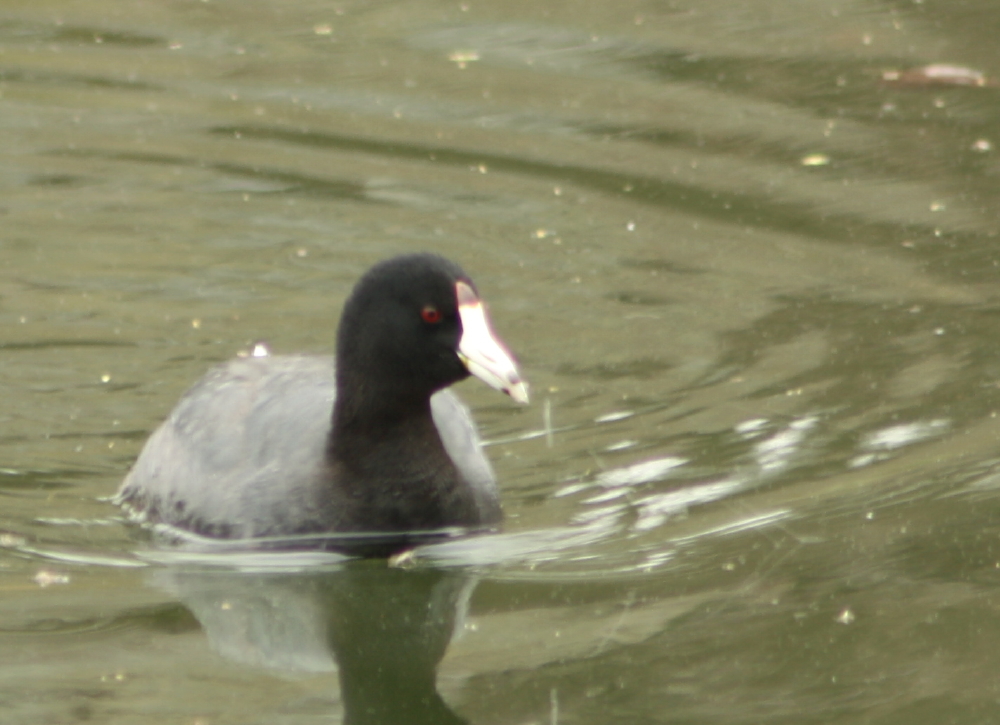
New Species #1: American Coot

This guy was adorable.  His head moved back and forth as his little legs carried him through the water.  He's about half the size of a Wood Duck - so this is one small waterfowl.  And he was out there by himself.  I didn't see another like him or a female that would appear to go along with this guy.
New Species #2: Brown Creeper

 
Last year I would have assumed this was some sort of sparrow.

Not even close.

It's a Brown Creeper.  It's like a nuthatch, only not.  A nuthatch goes head first down the tree when foraging for food.  Creepers spiral up.
New Species #3: Chipping Sparrow


Here's one of my "it's a sparrow" birds.  I never really looked much closer.  This one is distinctive because of his little red and gray 'mohawk' of feathers on top of his head.
New Species #4: Eastern Towhee


 At first I thought this was an oriole.  And I wasn't too far off.  He is in the same family.  The reddish brow patches on his sides really stand out when he flies.
New Species #5: Gray Catbird


To be fair I did *see* one of these last fall at the Hedge, but I couldn't figure out what it was.  I'm learning to ask the birders I see out with their binoculars if they've seen anything interesting.  If nothing else, it gives me a name or two to Google when I get back.  I also know of a great website that tells me what species are close to the one I'm looking up.  For example when I looked up "oriole" for the one above it said, "Similar species: towhee" so I knew to check that when oriole was clearly not right.

New Species #6: Greater White Fronted Geese

 Another set of animals I think I've seen before.  I'm pretty sure this pair of geese hangs out in the North Pond, or near it, year-round.  They aren't tagged as belonging to the nearby zoo, but they're the only two of their kind I've seen.  I have to say this: I like these guys a lot better than our 'garden variety' Chicago geese - those are Canada geese.  They stay in Chicago all year, despite their name,  and are mean as all get out.

New Species #7: Hermit Thrush

Something else I would have called "some kind of sparrow" and wouldn't even have been close about.
New Species #8 and #9: Barn Swallow and Tree Swallow


Two for the price of one!  Yeah, I know, it's an *awful* picture.  They were really, really at the limit of my telephoto lens.  I'm hoping to go back and actually get good pictures of them.  But they're swallows and it's amazing to find them sitting still for more than six seconds.  These were the guys that gave me the Alfred Hitchcock feeling. They were swooping around *all over*.

The one on the left is a Barn Swallow.  His buddy on the right is a Tree Swallow.  I don't think they hang out in Chicago for very long.  I don't remember seeing them at all last year and with the huge numbers we're seeing now, I'm pretty sure I would have seen a couple in the summer if they'd stayed.  So we appear to be a stop-over on the way to either Michigan's UP or Canada or something.

New Species #10: White-Crowned Sparrow
 So I was saying about the 'black and white headed' sparrows.  They're White-Crowned Sparrows and there seems to be tons of them this year.
 So that's ten to get started with.  I suspect it'll be easy to get the first 25 or so, but then I'll stall out when it's all "It's another chipping sparrow" or "Gee, look, another thrush."  I have a few more, but they'll go in the next post so I don't kill anyone's computer with too many pictures in a post.

Friday, July 16, 2010

North Pond - July 14, 2010 - Post #2

Okay, here we go again. More shots from that same walk I was talking about yesterday.


A purple coneflower. More fun with macro mode. [Coneflower Near the End of the Road]


I'm learning to do a lot more with manual focus. For example, I wanted to focus on this grackle with a seed in his beak, but my camera kept insisting on focusing on the green leaf in front of him. It's trickier to get a shot quickly, but if your subject is sitting still for a minute, you do get a much better shot.

[Grackle with Seed]

This guy was adorable. He came creeping down from a higher branch and seemed pretty shocked to see me standing right under his nose. But instead of running back up the tree, he just flattened himself against the branch like, "You can't see me. I'm blending in!" Too bad the tree was mostly green from lichen. :)
[Flat Squirrelly]

Peekaboo turtle! Don't let fables fool you. Turtles - at least Chicago turtles - are pretty fast. This guy would hear my shutter, duck back under water swim a few yards, pop back up. I'd catch him, he'd duck under and come back up somewhere else. Very, very quickly. I love that you can see his feet and shell under the water in the breaks in the algae. [Peekaboo Turtle]

Near as I can Google, this is an upside down Carpenter Bee. I think the flower he's on is some kind of onion variety. Anyone know?

[Carpenter Bee]


Most adorable shot ever! The "Rainbow Duck" shot from yesterday is mom. She was swimming around this log while her babies sat up high and dried and preened and rested. I still need to look up what kind of ducks they are.

[Ducklings on a Fallen Log]


I love this as an artistic shot. I also love that my Google-fu found that this plant is called Blue Vervain and that the bee is a female bumblebee. This is the kind of shot that I end up filing away for the next Art Sharks or contest I find.

[Bumblebee and Blue Vervain]


So, truthfully, the smaller you make this shot, the better it looks. :p He took off, I held down my shutter and just followed him as he went. The good news is, the camera did know what I was focusing on (as evidenced by the almost invisible, yet still visible enough to be annoying tree branches in the foreground), the bad news is, there's a lot of blur when trying to catch a heron that's diving for its dinner. [Heron Goes Dinner Diving]

He's so much easier to catch well when he's sitting still. :)

[Juvenile Great Blue Heron Watches the Horizon]


And here he is in all his glory. And in context. I think I may have inadvertently focused on his chest because it's a little more in focus than his head. But given the distance I was at when I took this, I'm surprised it came out as well as it did (even if I did have to darken it a bit in Graphic Converter). I love how you can see the darker feathers coming in on his chest and in his tail. And a little detail? Look at the zig-zag reflection of the grasses in the water. [Young Heron in the Grass]


Okay, ten pictures make a post. Let me know what you think. :)