Showing posts with label landscape. Show all posts

Saturday, July 13, 2013

Being Bicostal means Starting with One Coast - The Atlantic Ocean - Costa Rica, Part 9

This trip took us into 6 of the 7 provinces in Costa Rica.  It's a really small country, if I haven't mentioned that before.  The comparison that always sticks in my head is that it's only half the size of the state of Kentucky.  And Kentucky is no Alaska or California, if you know what I mean.

So once we left San José, we headed for Tortugero, which is is on the Atlantic coast.  The Tortugero school, which I'll talk a bit about later, was right on the Atlantic beach.  Now, maybe it's because I see the Atlantic (well, the Gulf of Mexico) at least once a year, but I didn't find it nearly as interesting as the Pacific Coast.  I've only seen the Pacific twice in my life.  It also, I'm sure, has something to do with the particular geography of the parts of each coast that I saw.  The Pacific coast of Costa Rica, where I was anyway, was full of volcanic tide pools.  The Atlantic beach was, well, just sand.

That's not to say that it wasn't pretty.


All said, it was a pretty calm stretch of water.  Nothing anyone could surf on. :)


I did find it interesting how black the sand is in certain parts.  Our guide, Johnny, said it's because its volcanic sand.


And there was one very cool thing that we was in the Atlantic Ocean.  Again, thanks to Johnny, I got this very distant, very blurry shot of an animal I could potentially never see again...


Can you tell what it is?

How about if I zoom in?
Green Sea Turtle [007-2013]

It's the flipper from a Green Sea Turtle.  Well, probably a Green.  It was a Green that we saw later that night, but there are something like 5 species of Giant Sea Turtles that breed near Tortugero.


I did get a better chance to see a Sea Turtle, but unfortunately I wasn't able to take pictures at the time.

Tortugero, which means 'turtle' in Spanish, is the home to the Sea Turtle Conservancy.  When we got into Tortugero on Tuesday we did cross the river to see the center and watch a movie on the efforts to save the endangered population.  However, the rain prevented us from doing much of anything else while we were over there.  What we were able to do when we got back to the hotel was to sign up for a Sea Turtle Spawning Observation Tour the next night.  So I paid the fee, dressed all in black, like they told us to, and in the middle of the night, with another storm coming in, we hiked down to a restricted section of beach with the local guides.

Once we were in small groups we stood an waited for the spotters. The spotters simply walked up and down the beach, in the dark, waiting for the female turtles to come up on land and start digging their nests.  Once one was sighted, they radioed to the leaders of the groups and we were brought down one group at a time to watch an endangered Sea Turtle lay her eggs.

Now, if you've ever seen any nature specials about how turtles lay eggs, you know that they dig a big hole in the ground, sit over it, let the tough leathery eggs drop into the hole and then cover the hole up with sand and go back into the ocean.  So I couldn't imagine we'd see much.

But then we were called down and they explained that the female turtle is using every single bit of energy and concentration to lay her eggs, so people really don't bother her if they don't get around to where she can see them.

When we got down to where our spotter found one, I realized that we were going to be within touching distance.  The spotter was laying on his stomach, holding the turtle's back flipper up out of the way, shinning a red light into the nest.  Now either she didn't know or she didn't care, because she was busy dropping eggs as we came in.  Because I was one of the shortest people in the group I ended up right in front, kneeling down, not two feet from the edge of her nest.  We'd been told she'd lay about 125 eggs that night.  From what I could see when we got there, she'd only dropped about 15 before we got there and as we watched she must have laid another 15 or so.  Which meant she was going to be there a long, long time.  And apparently each female comes back to lay eggs about 5 times in a season, each clutch getting smaller and smaller.  Most turtles don't start laying eggs until early July, and it was late June when we got there, so the guides were pretty sure that she was laying her first clutch of the year.

It was a pretty amazing experience to see her laying her eggs from so close, but like I mentioned, there was a storm coming in.  We could see the starts when we got there, but as we waited for the spotters to call up, it was like the stars were going out a few at time moving in from over the ocean.  Mama turtle was still laying eggs when we started seeing rather a lot of lightning over the water and started feeling the first few drops of rain.  So we couldn't stay to watch her cover the eggs or go back into the ocean.

I was told that even if it rained really hard, there was no danger to the eggs because they'd either be covered by mom's body or by sand before the water could get in enough to do any damage or wash them away.

It really was an amazing experience.  My next trip needs to be planned for a time when the eggs would be hatching so I can watch the little guys (and girls) scamper for the water en masse!

Friday, July 12, 2013

The Value of a Good Point-and-Shoot - Costa Rica, Part 8

So if you've met many professional photographers, especially when you're walking around with your little point-and-shoot, you know that a lot of 'professional' people can be pretty dismissive of any camera that fits in your pocket.

I'll bet you a fair amount of money that those people are studio photographers who have the chance to control lighting, use a tripod, arrange and re-arrange their subjects and reshoot when they don't like the results they get.

Wildlife photographers are far more likely to understand why you might want the camera to do a bit of the thinking for you.  When the light is whatever nature grants you on that day, when your subject has a mind of its own and when you can't come back the next day and decide that 'everything sucked yesterday; let's reshoot!', you become much more attuned to thinking fast, shooting faster and trying to correct problems with the shot in post-production.

And, of course, there's the photography maxim that I think all photographers should embrace:  The best camera for a given situation is the one you have with you!

Getting a less-than-amazing shot of that rare butterfly is better than NOT getting a shot of that rare butterfly at all.  Catching your kid doing their first cartwheel on your cellphone is infinitely better than not having any picture to send off to those adoring grandparents.

And to top it off, some of the point-and-shoot pocket cameras are getting to be pretty good cameras.  The sensors have gotten to a point that unless you're doing billboard art, you'll be totally fine making 8x10 or even 11x15 prints from your pocket camera.  The one I took to Costa Rica was 16 megapixels.  That's actually more MPs than my SLR.

This camera has a few downsides, compared to the SLR - specifically, the digital zoom/macro is awful.  Give me a good glass lens for that stuff any day.  The battery tends to get sucked up by the screen and it has an auto-off that shuts the camera down to conserve the battery, but it means you lose a few precious seconds having to turn it back on when that critter you weren't expecting pops up out of nowhere. (I'll show you a huge toad that did that to me when I get to amphibians - I almost lost him waiting for the camera to power up.)

But there are things you can do with a good pocket camera that you can't do with many SLRs.  Off the top of my head: movies (unless you have one of the very recent SLRs), panorama shots, and shooting in/near the water.  (Please be sure your pocket camera is waterproof/water resistant before doing this!)

So while I won't be trading in my SLR any time soon (ever), I'm rediscovering the value of having a pocket camera on me at all times.  Most of the shots from this post were taken with my 'indestructible' (crush-resistant, water-resistant, fall-resistant...) Pentax point-and-shoot.

So here's another reason having a point-and-shoot can be a good idea:  casual photographers can use it.  I've had more than a few people either hesitate to shoot for me with the SLR and a few more that do so, but do it really badly because they aren't sure what everything does (like, hey, this wheel thing on the end of the lens turns!  So now it's out of focus) so the shots don't come out.  Here's me on the Poás Volcano.  I have my SLR over my shoulder, so obviously a friend from the trip shot this for me with my pocket camera.  There's one of the other mountain ranges behind me (sorry, can't remember which one) and the central valley, with San Jose, between us.  


And here's the aforementioned panoramic capability of the camera.  Can't do that (easily and in-camera) with a DSLR!


Here's just a few more scenery shots.  Like I've said before, I'm not normally the landscape and scenery type, but Costa Rica has some pretty amazing views.

When, you know... it doesn't look like this.  This is up on the Poás Volcano... I think.  We were up a good bit, so I'm pretty sure that's where we were.  And once again, we were reminded that we were in the RAIN forest.  Which means clouds.  And once you get up high enough, you literally have your head (and feet and arms and the rest of you...) in the clouds!

And then there is the upside to the SLR being able to be left on, so I don't lose shots due to camera warm up time...

These shots were taken as the bus was moving.  Because the camera was on and waiting I was able to get these pretty good shots on the fly.  Drive... whatever. :)

This is the Rio Sucio, or Dirty River.  The water is yellow because of the sulfer deposits it picks up from the Irazú Volcano.


You can see it snaking down from the river a bit in this shot.


But the shot I'm really amazed that I got is this one.  This is where the Rio Sicio joins with the Rio Honduras and you can see where the clear water of the Honduras join with the yellow waters of the Sucio.  I wouldn't have gotten these shots with the point and shoot only because I wouldn't have had the time to let the camera turn on.  Not to mention that checking the settings is more time consuming because you actually have to go through menus on the screen, whereas on the SLR, I just look at the dial on the top and I'm good to go.


Tuesday, July 9, 2013

And now the photos begin - My first view of the beautiful tierra verde - Costa Rica, Part 7

Okay, it took me a week, but I've finally completed the import/sort/keyword part of my workflow.  I had over 10,000 shots when I came home, so you can understand why it took a few days. :) Don't worry, I won't be subjecting you to all of them.  Just most of them. ;)

Weirdly enough for me, I feel like starting with the landscape and scenery shots.

I already showed you some of the amazing clouds we saw on the flight over.  Today's post is also shots from the way in.  My first views of Costa Rica.

This first shot shows just how high we were flying.  I mean, I knew we were up above the clouds, but usually that just means seeing a clear, light blue sky.  We were up in that area you see when people launch their GoPro or cell phone into 'outer space' on a weather balloon.  The sky is hitting that dark blue that eventually fades into space-black.


This is my first view of the ground when we broke back down through the clouds.  My first impression was, "Damn.  That is a *green* country."  Shot somewhat ruined by the weird covering over the plane window glass. :(


This was my favorite view.  You'd think not one human lived here.  It's so green, so natural.  There's not a speck of human effect on the land.
As we came in you could really start to appreciate the color that dominated the entire landscape.  You could also start seeing little dots of houses and buildings.  But there's still nothing like a large tract of deforested land.  It's all still so deeply green.

We were just a minute or two from the ground when we could start seeing roads and towns and things.  But on the whole, I'd discover, the population here was highly concentrated in San Jose (and although it's SJO airport, you aren't actually IN San Jose when you land, so we weren't really seeing the city proper from the air) so when you're in the country, you find that it's pretty rural and rustic.  And beautiful.  (Again, this is shot with the point and shoot through the airplane window, and I just couldn't correct it to make it less hazy.)

Okay, tomorrow, the ground from... you know, the ground. :)


Friday, April 1, 2011

Please excuse the load time...

These shots are for a critique session I'm attending tomorrow, so I'm uploading them full size.
A Break in the Clouds

Snowy Night

The Very Hungry Caterpillar

Unfolding

Mr. Fokker Poppy

Ripples in the Lily Pond

Bottle Gentians in Beautiful Blues


If anyone checking out my blog tonight has any critiques, I'd love to hear what you think too!

Wednesday, January 12, 2011

The Magic Hedge - 1.11.11, Post 3

Here we go again... :)  I'm finding that I have to do a lot of lightening of my shots in post-production.  Given that it was really light (I mean, it was cloudy and snowing, but it wasn't, by any means, dark) out and I was shooting snow, I have to figure my camera was somehow overcompensating.

Airborne Squirrel
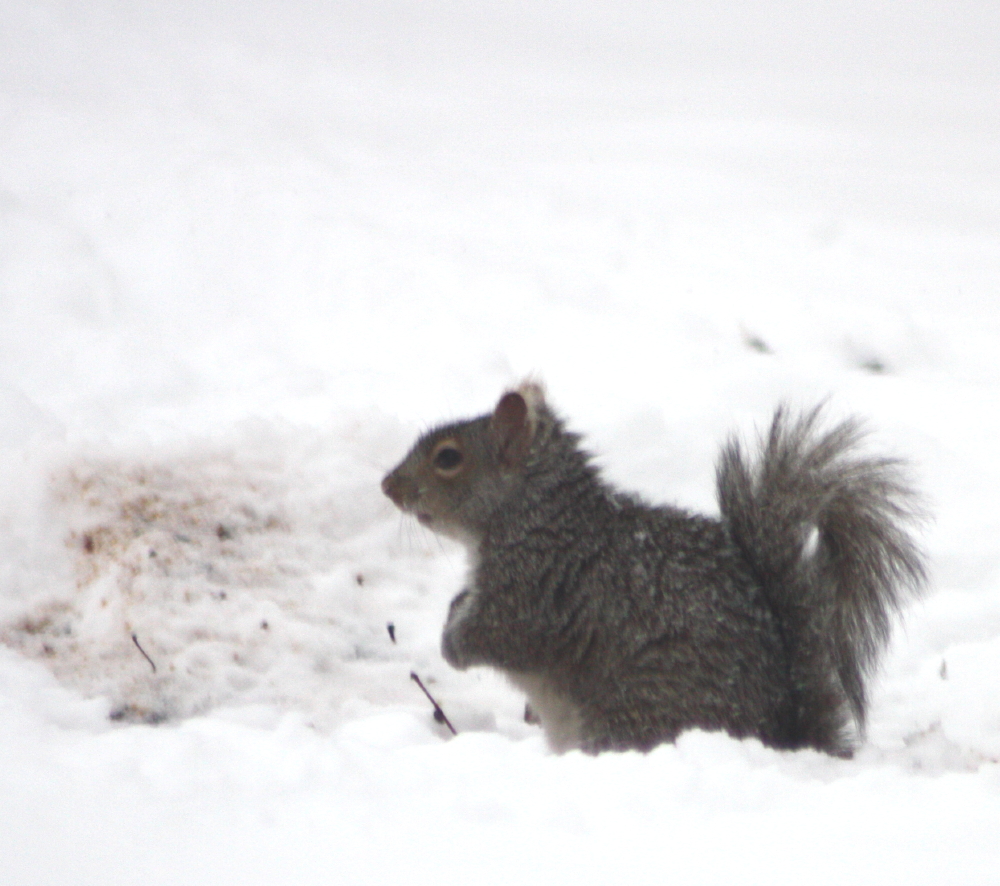
 Like I said yesterday, there were squirrels-o-plenty.  This guy was chasing another one.
Chilly Squirrel


This squirrel managed to look cold.  Most of them didn't. They were fat and energetic and having at the seed someone tossed down.  This guy... I don't know... he just looks chilly.
Standing Guard Over Seeds
I think this guy was afraid I'd take his seeds or chase him off.  He kept popping up like this and then going back to eat and popping back up to look at me.  I love how he's all chubby in the belly, but he has this kind of ratty tail thing happening.


And They're Off...
A geese-launch shot I forgot yesterday.  I didn't color correct this one.   I left it a little gray because it seemed to add to the scene for me.  Also because it gives you an idea of how my camera was perceiving the *really, really* white snow.
Your Insane Photographer


Here's a rare portrait of the (insane) photographer.  I ran into someone else out there taking shots with his S.O. so I offered to take a picture of the two of them together, so he said he'd return the favor.  I couldn't find my purple and gray hat, so I had the earband on.  I had really, really wet hair by the time I got home.
The Bird the South Forgot


Then there was this guy.  It's not a good shot or anything, but it's an American Robin.  What the *heck* is he doing here in this snowstorm?  As a kid I was always taught that the robins returning was one of the first signs of spring.  This robin?  One for the first signs of SNOW MY GOODNESS, SNOW!


Looking for Mr. Tumnis
 There's shrubbery arch in the Hedge.  I have no idea if this was crafted at some point or if it somehow naturally formed when branches tangled together overhead.  Anyway, add a little snow and you have the entrance to Narnia, I swear.


Snow on the Weeds

 The weeds of the summer and fall are clearly dormant now, but the stems still remain and have been picking up snow on any surface that's horizontal or close enough for jazz.
You Can't Spin This Cotton


It makes it look like we're growing cotton... in Chicago.  In January.  I love that in this shot, even at this size, you can see the snow falling.
Snow (on) Cone(flowers)
 Here's more of the little snow caps.  I'm pretty sure these were either coneflowers or sunflowers in the summer.  Now They're snowcone flowers. :)
Quiet


This needs to be made into a card or something at some point.  It just strikes me as ridiculously iconic "Winter".


There's more.  (There's always more with me, isn't there? :)  But that's enough for tonight. :)

Monday, September 27, 2010

Matthiessen State Park - 9.25.10 - Post 2/2

Okay, here are the rest of the Matthiessen shots... (told you I didn't take many. :)

Stepping on Stones
Because this is a water-worn ravine/canyon, there are lots of places with either flowing or standing water.  Which led to a lot of either natural or concrete stepping stones.  Some of which were more stable than others.  One of our group ended up with one very wet foot. Whoops!
Roots Protrude
Erosion is a huge force in the area, which means that tree roots that were probably under earth or rocks or even water are now exposed.
Tangled Roots
 Here's a tree that's still growing strong even with this much of it's root system exposed to the elements. 
Roots Creeping Across the Terrain
Here's the long shot of that same tree.  Look how far the exposed root system extends.
My Kitchen Tap Has a Faster Flow
 One of two small waterfalls we saw.  It's hard to see from the only angle I could get, but the water at the highest level falls into a small pool and then the pool spills over, very slowly, into the next level down.  You can see that it's more of a water-migration than water-fall at that level as the lower pool is very still and highly reflective.
Sticks and Stones... Don't Break My Bones.  Please.
More stepping stones.  With fallen logs for bonus difficulty.
A Face in the Log
 So then there was this.  A fallen tree right across our path.  Is it me, or does anyone else see a face?


Not the Gator You Thought I Was

It reminded me a lot of this one from Volo Bog.
None May Pass!  Just Kidding.
 Okay, I am, in no way, a fan of graffiti.  But this did amuse me a little.  It's like it's a gargoyle guarding the cavern.
The Ghost of Hikers Present
And one last oddity.  I was running a thirty-second shutter to try and get the back of this cavern.  I didn't realize one of our group had gone back into it to explore the passage that was on the left hand side.  She came out and walked through my frame.  If I ever want to convince someone I've photographed a ghost, I know exactly how to do it now. ;)

Okay, that was it for this hike.  Like I said, I suspect it'll be better in the spring or summer, but I'm not looking to drive 2.5 hours each way again to get there anytime soon.

Matthiessen State Park - 9.25.10 - Post 1/2

In a little, tiny town called Utica, Illinois, there are two state parks.  One is the very well known Starved Rock, the other is Matthiessen State Park.  A group I belong to had a trip to Matthiessen planned, so I figured it would be a great chance to go shoot a site that's over two hours away and not have to make that drive on my own.

Which... worked up to a point.  I didn't have to make the drive on my own, but I remembered what happened the last time I had this thought (go with the group so I'm not out in BFE on my own)... I get highly annoyed at how fast everyone moves; I really do better when I go shooting on my own or with another photographer who understands 'move slowly and quietly'.  I mentioned something to the group leader about not wanting to sprint through the park, and she said we wouldn't be, but um... yeah we were.  And I don't mean that even from a photographer's standpoint.  Even if I'd left my camera in my car, I'd feel this group was trying to make land speed records.

Nevermind the fact that I was actually trying to take a few pictures.

Not helping at all is that this is a split-level park - there's an upper dells and lower dells section, which means there's a lot of stairs.  It's not like you go down, stay down and then come up and stay up.  You're up and down all over the place.  At one point we did 148 stairs consecutively (according to the signage).  That's roughly the same as going up (yeah, this was 148 stairs UP) 14 floors of a tall building.  Did I mention that my asthma deals with hiking across all kinds of land, but really, really hates doing stairs?  Ugh.

Overall, for this time of year and for a Saturday and for the the kind of photography I do, I'd give this park a D.  It's very, very busy.  Which means there are no animals anywhere you can see.  I heard some birds - I'm quite sure one was an owl - but other than the occasional blur streaking across the sky, I didn't see one animal.  We're also just far enough into fall to be at that awkward place where the interesting flowering plants are pretty well gone, but the really spectacular leaves haven't come in yet.  So ... it was pretty boring photographically speaking.

Between trying to break the four-minute-mile and there not being much to see, I only shot about 2 gigs of photos.  Comparatively, I hiked a place I wasn't ridiculously keen on last week (photos will get up eventually) where even though I was still in the middle of urban civilization, there were enough animals and flowers that I took about 10 gigs of photos in the same amount of time.

There were a lot of people in the woods that day.  A lot of kids and a lot of families with dogs.  So, again, no chance the wildlife was going to stick around.

I shot this sign when I was in the parking lot, waiting, just to test the equipment.  I find it kind of funny now...


See rule 4?  My initial reaction was, "Seriously?  Who's going to go wading in a forest lake?"  Well, we got up to the "Wishing Well" part of the park and there was a lagoon that was very, very low.  Which left a muddy bank from about five feet up the rock wall into the lagoon, which (judging by the dog swimming and playing in it) had to be at least four feet deep.  There were a couple of kids running up the bank and sliding down the mud into the water on their butts.  At first I kind of gave their dads a dirty look, like, "It's 60 degrees and I'm pretty sure you aren't supposed to let your kids play in the water."  (Not that I'd ever say as much, but I thought it).

And then I realized that thirty years ago, my brother and I would have been doing *exactly* that same thing.  My father would have been encouraging it while my mother stood to the side hoping there wasn't a stick popping up out of the mud that we'd snag on or a sharp rock on the bottom that we'd cut ourselves on (but not disallowing it or freaking out over what sliding in all that mud would be doing to our clothes.)

Speaking of signage, this one, from the auxiliary parking lot kind of cracks me up:
Don't get the impression this sign is old, but a.) it doesn't list 911 as an emergency number and b.) it doesn't give the area code.  And we were pretty far out in nowhere-Illinois, and I really don't know what the area code is out there.  I'm thinking we were too far south to be in 815 any more.  So my cellphone, which requires 10-digit dialing, would have been problematic.

I do want to try the place again in the spring or summer and preferably on a weekday when it's apt to be less crowded and have more interesting flora and fauna visible.

But, all that said, I did get a few interesting shots.

Long Lake
 Water is an integral feature of the park.  Largely, it's based on a canyon (hence the hiking back up 14 flights) that is carved by running water, much the same way the Grand Canyon was carved (only on a much, much smaller scale.)  This is one of the lakes that still had water.  You can see that some of the trees (but not many) are starting to change.  I really like looking at the reflections in water pictures.  It shows how still the water is now.

Carved Cavern in the Canyon
The canyon, I'm told, has an actual river running through it in the spring, but by the fall it's pretty dry and the water that is there is pretty still.  But you can still see the way the sandstone has eaten away the walls of the canyon and left caverns in them.
Rainbowed Cavern
To the right of this picture is where the kids were playing in the mud.  Despite their splashing and sliding, the water flattened quickly, the ripples didn't travel far.  I wonder if that has anything to do with the lime in the water.  I like this shot because of the different deposit layers and micro-flora layers on the rocks.  In the back you can see oranges and reds and purples from the sediments in the water and on the left you can see blues and greens from lichens and mosses and other 'air plants' like small ferns.

Crack in the Canyon
Here's one wall in the canyon with a grove cut in it.  I'm sure that when it rains hard enough, there's a fantastic waterfall here.  There are trees sticking out of the rocks all over the place in this park.  Sometimes gravity wins and the tree gets pulled down.  In certain places they create bridges that I'm sure the squirrels and such love.  In other places you just have these tree trunks hanging off the side of the cliff, their roots still holding them up even though the tree wasn't alive any more.
Quiet Creek
Here's the trickle of river that remains this season.  The water is brown from tannin in some of the plants and their parts (like acorns) falling in it.  It's not just muddy.  Even the clearer pools were usually gold or brown in color from this.
Sandstone Erodes
 Sandstone layers and small caverns. 
Sulphur Shelf Spots
One bright spot of color that I did find were a few samples of this orange fungus.  This is called a "Sulphur Shelf" fungus, and is apparently edible.  No thanks.  It's pretty though.

We Don't Need to Put Down Roots
A lot of the rocks had plants growing on or out of them.  I'm not sure what those long finger-looking plants are.  They have the texture of a regular leaf, but they seem to creep and grow like a lichen or moss.
Rocks Reflect
Another reflection.  You can see how still the water is as well as how dark the tannins make it.


Okay, I have one more post for this hike - not nearly as many as I would have liked to have had, but I think we're hitting that place where I need to resign myself to the fact that we're heading into that season where nature shooting gets a little bit harder.