Showing posts with label wildflowers. Show all posts

Wednesday, May 2, 2012

Fullersburg Woods Forest Preserve - 4.15.12 - Post 5

Alrighty then.  Last post for this new place.

Dandelion (039 - 2012)
So I talked the other day about being more conscious of shooting the common birds.  There are also a few common plants I need to think about too.

One of the more ubiquitous wildflowers out here is the dandelion.  In fact, it's so ubiquitous, it's considered a weed.  But let's face it, all a weed is is a wild plant that's growing somewhere you don't want it.  I love that these are growing inside an old tree stump.

Celandine Poppy (040 - 2012)

I'm getting better with the flowers.  This is a Celandine Poppy.  I find it interesting because I'm not used to seeing flowers with only four petals.  It's the same reasons I find the Trilliums interesting.  They have three.
Nobody new here, just another Blue Jay.  Still working at a *good* Blue Jay shot.  But the reason I'm including this guy is that as I was walking I heard this incredibly loud screech.  I was sure there had to be hawk or an owl or other large predator bird doing it.  I had seen something that looked vaguely hawkish off in the distance over the river.  But when I finally got close, I realized it was this guy.  I could not believe a body this small could make a noise that loud!


He actually moved from tree to tree quite a bit as another photographer and I tracked him, but he stayed pretty well in view despite all that moving.
Bellwort (041 - 2012)


For some reason I got it in my head that I'd already blogged these at some point, but if I did, I can't find it now.  So I'm guessing I didn't.

These are bellwort.  An interesting little yellow flower that hangs upside down.

No actual species here, I'm not even sure what the tree is, but I love the evidence of beavers here.  I'm also slightly amazed that the tree hasn't fallen yet.


So that's Fullersburg!  I want to go back out there in May when migration is more thoroughly underway.  It was a nice park with a lot to see and not an insane amount of people to compete with.


Total Identified Species Sited for the Year: 41
Total Unidentified Species Sited for the Year: 1
Total New Species: 23

Dandelion*
Celandine Poppy*
Bellwort

Tuesday, May 1, 2012

Fullersburg Woods Forest Preserve - 4.15.12 - Post 4

Here we go again! :)  More Fullersburg Woods spottings.

One of the real stories of the day was the sheer flocks of Red Admiral butterflies.  I mean, I could stand on the path and look at some of the nearby flowers and there would be six or seven of these guys floating around.  I'd walk 20 feet down the path, look at some flowers and see six or seven more.  And the whole place was like that.

Red Admiral Butterfly (035 - 2012)
Red Admirals aren't uncommon in the area, but we tend to get a lot more Monarchs and Painted Ladies and smaller butterflies in the Whites and Sulphur families.  So the large number of these guys was notable.  And they aren't just hanging out in forest preserves - which is the only places I've seen them before - they're around the block I live on!  I've seen them in really busy Chicago neighborhoods.  The news is even covering the abundance of these guys, there's so many.
Now one of the nicer things about being in 'the middle of nowhere' in the middle of Northern Illinois, is that I can still get cell phone reception out there.  So I googled Red Admiral caterpillars, to know what I was looking for, but even then I didn't see any. :(  I'll keep looking though.

There were also herds of little white butterflies that didn't, from what I could see, have the black spot that marks a Cabbage White.  But not one of them would land for more than half a second.  Not one.  So maybe if I go back out there next month I'll have better luck with those.

This is another flower that was tricky to research.  Turns out it's a Wild Geranium.  It's about an inch across, so it's a pretty small flower. 
Wild Geranium (036 - 2012)


I love the clarity of this shot.  The clear dark veins in the petals, the anthers that are bright yellow with pollen.


Great Black Wasp (037 - 2012)

The bees and wasps are slowly making their way out.  This Great Black Wasp was hanging out near the Red Admiral Butterflies


I need to start working on using a fill flash when I'm outside just to let the camera move a little faster.  This could have bee a really cool shot if the ISO were lower and the shutter was a bit faster.  You can see the hairs on the wasp's feet, but where his wings were moving a bit and his antennae were clearly moving, there's too much blur.
 And this is where I wish I had my tripod.  This Great Blue Heron was just hanging out on this downed tree on the other side of the river for a very, very long time.

I would have loved to have been able to use a narrower aperture to get this guy, because clearly there's too much light here and there's still blur, which means the shutter was open too long to be done well hand-held.

The heron was itching and moving and ducking around to stretch as I was watching.  Here you can see the length of his neck, even if it is all folded up under his head.
Great Blue Heron (038 - 2012)


Here you can see him scratching an itch on his head.  It made his white crown pop up.

On a photography note, you can really tell the difference between the shooting modes I was using.  In the first two I was on 'action' mode and let the camera make the decisions for me.  It chose f5.6 at 1/200th of a second.  It also clearly changed the setting of the white balance and it upped the ISO to 200.

On this one, you can see that it looks much greener.  This was done on Av (aperture priority mode, meaning I set the ISO, the white balance and the f-stop, the camera chose the shutter speed).  I had it on ISO 100, the white balance was set for a cloudy day and the f-stop was 5.6 here also.  The shutter speed was a much slower 1/50th.  You can clearly see what the difference is between the two white-balance settings.  The first one has a lot more blue and this one is a lot more yellow.  Honestly, I think the true light values were somewhere in between.

Okay, one more post on this walk then I need to double back around and do the North Pond walk that I actually did between the last Magic Hedge trip and this trip.

Total Identified Species Sited for the Year: 38
Total Unidentified Species Sited for the Year: 1
Total New Species: 20

Red Admiral Butterfly
Wild Geranium*
Great Black Wasp
Great Blue Heron

Monday, April 30, 2012

Fullersburg Woods Forest Preserve - 4.15.12 - Post 3

Okay, the next set of spottings...

Prairie Trillium (028 - 2012)
 So I first noticed Trillium in Tennessee.  I didn't think we had it up here, or at least I'd never noticed it before.  But hey, look!  The one in Tennessee was called a "Sweet Betsy".  This one is called a Prairie Trillium.  At first I couldn't see much of a difference between the two, but one of the websites I looked at made me look at the leaves closer.  These leaves are two distinct shades of green.  The Sweet Betsy has solid leaves.  It also has taller, thinner flowers than this.

Eastern Gray Squirrel (029 - 2012)
They're pretty ubiquitous around here, but I found this Eastern Gray Squirrel to be pretty adorable.

He's the original tree-hugger. :)

He didn't see me for a while , but you can see in this shot that he'd finally figured out what was going 'click-click-click'.


Which prompted him to do this.  Turn ninety degrees and hang out sideways for a good long time.  Strange little dude.  Cute... but strange.
Tiger Beetle (030 - 2012)


The arthropods and other cold-bloodeds started sticking their heads out in March when we had that freakish warm spell.  But for the most part, they've gone to ground as the temperatures have normalized.  This lone tiger beetle was the only 'crawly' I saw this trip.  There will be butterflies later, but this is the lone 'bug'.
Blue-Winged Teal (031 - 2012)


 Okay, this shot is *abysmal*, which is really disappointing.  It's a totally new species and from pictures I've googled they're cool looking water foul.  But at least now I know they're around and what I'm looking at when I see them.

It's a Blue-Winged Teal.  Teal, in this case is the type of bird it is.  Like we'd say 'duck' or 'goose' or 'grebe'.  So it's not in one of those groups.  It's in the group called 'teal.'

So, I know this shot is awful, but since I'm pretty sure I've never seen one before, I don't want to take the chance that I won't see another one.  So for now, I'll post the horrid shot, and hopefully I'll be able get better ones before migration is over.  (This was one I was glad I had the magnet board in the visitors' center to check the species on, because the picture is so incredibly bad.)
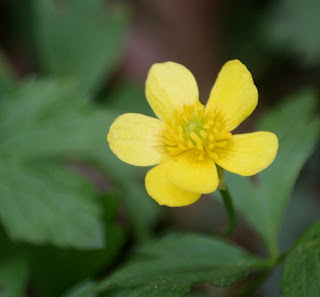
Creeping Buttercup (032 - 2012)
Okay, wild buttercups have a tendency to look a lot alike.  Now, there's a sign in the cultivated area that says these flowers are swamp buttercups, but when I Google that, I get a very different picture.  So I poked around for a while longer and what I think I actually found out in the 'wilds' was a Creeping Buttercup. If anyone is better with Illinois wildflowers and has a better idea, I'd love to hear it.  Thanks!
American Robin (033 - 2012)


So it occurred to me the other day that I'm ignoring some species because they're as common as dust around here.  Then I realized that my blog has been seen in 35% of all the countries in the world. Which means that for at least a few people, what's common to me probably isn't so common to them.

One of the things I haven't been blogging and counting are what I think of as 'the six second grade birds.'  See, when I was in 2nd grade (about 7 years old) we had to learn to identify the 6 birds we were most likely to see wild in Northern Illinois: sparrows (and they were all just lumped together, but I think mostly we saw pictures of house sparrows), robins, crows, cardinals, mallard ducks and Canada geese.  So to me, these things are just everywhere and not that 'special'.  But I should probably get them in here if I want to have as complete a record of what's around here as I can get.

Also fair to note, apparently the American maturity rate has sunk to about eleven years old and gotten stuck there long enough that they renamed this bird since I was in 2nd grade.  We learned it as the "Robin Red-Breast".  You know like the White-Breasted Nuthatch from the last post?  Well, apparently the word 'breast' is now too controversial so it's now called the "American Robin."  Dear school children and those who act like them over the name of a bird... Grow up. 

Red-Breasted Woodpecker (034 - 2012)
So from the very common to the quite uncommon.  I know I saw one last year, but that was it.  I saw one.  All year.

And apparently I never got it blogged, which makes it new for the count. :)

This is a male Red-Breasted Woodpecker.
Possibly one of the strangest names ever for a bird.

Now, given, Red-Headed Woodpecker was already taken.  But still, look at that first picture.  Do you see any red on his breast?  And it's not just a weird specimen; when you check on line, the notably red part of this bird is his head.  His chest is mostly white with maybe a bit of a rose blush.  I totally don't understand how this bird got the name he did.  (On the flipside, at least he's rare enough that he didn't have to undergo a name change to avoid making school kids giggle like crazy every time he came up in conversation.)


In this shot you can see that he has a bit of blush around his eyes and red around his beak... but still no red breast.


Okay, that's it for this post.  More sightings tomorrow.


Total Identified Species Sited for the Year: 34
Total Unidentified Species Sited for the Year: 1
Total New Species: 18

Prairie Trillium*
Eastern Gray Squirrel
Tiger Beetle
Blue-Winged Teal*
Creeping Buttercup*
American Robin
Red-Breasted Woodpecker*


Sunday, April 29, 2012

Fullersburg Woods Forest Preserve - 4.15.12 - Post 2

So here we go with the first set of spottings from Fullersburg...

White-Breasted Nuthatch (025 - 2012)

Here's my one new bird for the walk.  I saw a lot of birds, got some good shots, but I think this was the only one that was brand new for me.

This is a White-Breasted Nuthatch.
Nuthatches and creepers are really similar birds in both shape and behavior.  The easiest way to tell them apart - mostly - is by watching them on the trees.  Creepers will *always* go head down and around in a circle.  Nuthatches will travel in any direction, their heads going the way they're going.

So, of course, I happen to catch a nuthatch that's going down the tree, head-down.  Which led to me researching creepers for far too long before I realized it wasn't one.  *sigh*

Virginia Bluebells (026 - 2012)
 I didn't realize we had wild bluebells in Illinois.  I think I've mentioned before that I love seeing blue in nature.

 One of the nice things about Fullerton, besides the indoor chart, is that they have a cultivated area where they've put in a few of each wildflower and a sign that tells you what they are.  I know I've advocated shooting the signs before.  All these shots are from places I found them outside the cultivated area, but it was really nice to get shots of the signs and the planted bits, because it makes identification so much easier when I get home.

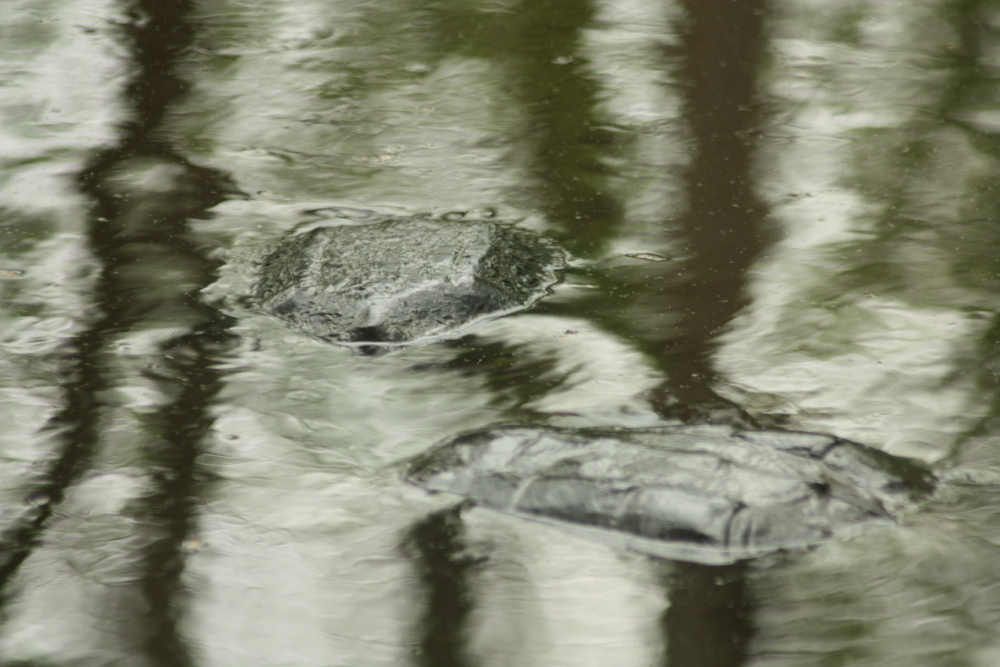
So, the rest of this post will be about the Common Snapping Turtles I found courting when I was walking near the river. 

Putting this spotting up at ProjectNoah.org was awesome, as there were some people there who gave me some great information.
Common Snapping Turtles (027 - 2012)
Neil Dazet told me, "Those 3 ridges that you see in the 2nd picture are common in this species, but they tend to smooth out and be less defined in older individuals. Also, female snappers are slightly bigger than male snappers. So it looks like an older male snapper attempting to mate with a younger female."
 Which, just... how awesome is that?  I know which species I've got, which one is which gender and their relative ages!  So cool!
 They were in the water the whole time and most of the time (and I was watching for about 15 or 20 minutes), they were 'hugging' - carapace to carapace with their legs holding on to each other - most of the time.

 During this time, I saw more soft parts of turtles (no, not like that!  Well, not that *I* could recognize anyway) than I ever have before.


They were so unconcerned with me that I was even able to sit and take some video of them.


 So you can start to see why my accidental walkabout (due to the broken bridge) wasn't the worst thing that's ever happened to me. :)  More animals tomorrow!


Total Identified Species Sited for the Year: 27
Total Unidentified Species Sited for the Year: 1
Total New Species: 14

White-Breasted Nuthatch*
Virginia Bluebells*
Common Snapping Turtles*

Sunday, April 22, 2012

Magic** Hedge, Post 2/2 - April 6, 2012

This is the last set of shot from my inaugural walk through the Hedge this spring.

Honeysuckle (2012 - 021)
 So it actually occurred to me to shoot the Honeysuckle Hedge that was the origin of The Magic Hedge Name.

I'm also just now noticing, I never explained the Magic Hedge.  (Or if I did, I did a horrible job labeling the post.)
 So Honeysuckle is an invasive species in Illinois.  I spent several hours on a work detail last year hacking a bunch of it out of a forest preserve.

It's in the Montrose Point Bird and Butterfly Sanctuary as a leftover from the days when Montrose Point housed an army base.  There were barracks where the actual hedge is now.  And to keep some measure of privacy for those who lived on the first floor, they planted the honeysuckle bushes.  When the army pulled out, they leveled the buildings, but left the honeysuckle.  Pretty soon, people started noticing that a lot of migratory birds were hanging out in this old, abandoned army location and it was reconditioned as a nature preserve.  So the actual hedge is still there, but it's the only real remainder of the old missile launching site.  So even though the honeysuckle really doesn't *belong* there, I suspect no one will pull it out due to it's connection with the site's history.

Common Blue Violet (2012 - 022)
So this is newly-blogged flower.  The Common Blue Violet.  It just so happens to be our Illinois State Flower.  So it's probably about time I got around to shooting it. :)
Cabbage White Butterfly (2012 - 023)


And my first butterfly of the season.  A little Cabbage White on a Dandilion.
This is the kind of shot that reminds me why it's worth it to drag my tripod through the woods when it's at all feasible.

These appear to be Ranunculus bulbosus or St. Anthony's Turnip or bulbous buttercup.  Normally they bloom from April until June, which means that being out and this large on April 6th is odd, but given a March that had temperatures frequently in the 80's we're finding that most of nature is about 3 to 5 weeks ahead of schedule.  These are an introduced species, but they seem to be doing quite well here in Chicago, hanging out with the other invasive from this post - the honeysuckle.  (Now all I need is a European Starling with them and I'd have an invasive species hat trick!)

Up next, a new locale and a truly ridiculous number of butterflies!


Total Identified Species Sited for the Year: 24
Total Unidentified Species Sited for the Year: 1
Total New Species: 11

Honeysuckle*
Common Blue Violet*
Cabbage White Butterfly
St. Anthony's Turnip (Buttercup)*

* - New Species
** If you notice every once in a while I typo and type "Magick Hedge" with a k.  It's not that I don't know how to spell the word, it's that I had a ferret who was Magick-with-a-k for years and I wrote about her way more than I ever did prestidigitation, so my fingers got in the habit of adding the K.  Sorry for the ones I don't catch. :)

Monday, April 16, 2012

Plants of Bledsoe Creek - Tennessee, Part 3

There were a fair number of wildflowers growing at this particular park.  Here's hoping my Google-fu will let me figure out at least most of them.

Columbine (2012 - 010)
 This one is columbine.  We have this one in Illinois. :)
Sweet Betsy (2012 - 011)


This is called a Sweet Betsy.  It's in the Trillium family.  The map I found for its range says it does make it up to Illnois, but I get the feeling the map filled in the whole state, even if the plant doesn't appear in all areas.  In this case, I'm guessing it stays further south in the state.  I've never seen one up here in or near Chicago.
 So these are three shots of the same plant.  As my dad and I worked our way through the forest we kept finding large piles of these flowers laying on the path.  Not off the path, just on the path.  And we couldn't find any still on the plant it came from for ages.
 Eventually we stumbled upon this one vine that still had their flowers.  It's called a crossvine.  Like the last flower, it apparently comes up into Illinois, but I've never seen anything even remotely like it up here.  The only climbing vine flowers I've seen in the wild up here are morning glories.
Crossvine (2012 - 012)


Here's a long shot of the crossvine stretching between two trees.


Rhododendron (2012 - 13)
 This is some form of Rhododendron, but from what I see around the web, that's like saying "It's some kind of dog".  There are apparently a ridiculous number of distinct varieties of Rhododendron, and figuring out exactly which one this is is tougher than you'd think.


Rhododendron
This appears to be another version of Rhododendron.  This bush was right next to the one above.  And again, with the over 1000 varieties (as listed on one website), I couldn't pin down exactly which kind this one was.


In summary, for my goals:

Total Identified Species Sited for the Year: 13
Total Unidentified Species Sited for the Year: 1
Total New Species: 4

Columbine
Sweet Betsy
Crossvine
Rhododendron