Showing posts with label new species. Show all posts

Monday, June 6, 2011

Lincoln Park Ponds, more new species - May 31, 2011

Wow, haven't posted in almost two weeks.  Sorry about that.  It's not that I haven't been out shooting, I just haven't had time to get a post together.

That and the fact that I'm completely obsessed with ProjectNoah.com.  It's a fantastic site to talk to people who do a lot of what I do here.

Anyway, on Memorial Day, May 31, I hiked all three ponds on one of the very first 90 degree (F) we had this year.  The weather has been very slow to warm up which has kept the cold-bloodeds in hiding for a long, long time.  They're *just* making their way out now, as the migratory birds (the warblers and some of the finches, etc...) make their way up and out of the city.

Sign of Summer
 One of my favorite signs of summer.  The dragonflies are back!  We don't have the clouds of them (okay, that may be a bit of an exaggeration) that we had around this time last year, but slowly but surely, a few species are parking themselves somewhere easy to photograph.
Bowing Carolina


  I'll need to go back and check my posts from last year, but I think I was identifying all the bright red dragonflies like this as Red Saddlebags, but while checking this a few dozen times before putting it up on Project Noah (I *love* that people there will correct you if you get a spotting wrong, but I'd prefer to get it right myself the first time if I can.)  Anyway, it turns out that this is, in fact, a Carolina Saddlebags.  You can tell because a Red has these clear patches on their wings right where they attach to the body.  This one is red to the abdomen, so it's a Carolina.  Another tell is that the last couple segments on the Carolina are dark brown or black.  They're the same red as the rest of the tail on the Red Saddlebags.

First Spotting of a Twelve Spotted
 Like last year, one of the first dragonflies and easiest to identify is the Twelve-Spotted Skimmer.  This guy would perch for about eight seconds, I'd get a few shots and then he'd fly off in about a ten foot radius circle and then come right back to this stick and perch again before starting the process all over.  Made it easy to shoot him.  I just had to wait a few seconds everytime he left, since I could depend on him to come back. :)

Red Ears with Their Eyes on Me
 Another one I've learned better about.  Last year I thought all the turtles in the North Pond were Red-Eared Sliders. Turns out a lot of them were Eastern Painted.  So when I learned that, I started thinking that maybe I was just getting them all wrong and they were all Painteds.  But no.  Here are some honest-to-goodness Red-Ears.  In this case you have a male (the smaller) and the female (the larger).
A Bee on a Bud


The bees are making their way out too.  Here's a honey bee checking out the early goldenrod.


And about the time the bees come out, the wasps come with them.  Clearly my "this can puncture me and I should flee" instinct didn't recover over the winter.  I'm still trying to figure out which kind of wasp he is.  Any ideas?

Okay, so this guy clearly isn't cold-blooded, but I was really chuffed over this sequence of shots I got of him coming in for a landing.


I would have loved for that last shot to have been a little clearer, but he landed pretty far back. It's still a fun series of shots, though.  Night Herons are about as exotic as we get out here.

The Carolina Saddlebag and the Red-Eared Sliders (properly identified) are my only new species for this post, but that brings my total up to 35 of my 50 new species.


Monday, May 23, 2011

New Location - the Bill Jarvis Migratory Bird Sanctuary - 5.22.11

So I was walking through the Hedge last week when I saw this sign:


Now, I know the Lily Pool well.  I was just complaining about having hiked over there from the South Pond last week only to find that it still isn't open.  :(  But I hadn't heard of this Bill Jarvis place.  I think the sign must be new, because I'm pretty sure I would have seen it before, I'm only at the Hedge about once a week.  And I'm at the North Pond almost as often.

Anyway, I came home and Googled this place.  It's near the golf course on the east side of Lake Shore Drive on the North Side.  Or, as the directions I got said, "East of Lake Shore Drive, at the end of Addison Ave. (3400 N.)

Well, I was going to be in that general vicinity yesterday morning so I took all my photography gear with me and planned to stop on my way back.  According to Google Maps, I needed to take the 36 bus back down Broadway and then walk the few blocks east to Lake Shore Drive and then cross it, and basically I'd be there.

If you're from Chicago, you see the problem.  If you're not from Chicago, imagine crossing your area's busiest eight-lane expressway.  Not a highway with cross streets that will cause cars to occasionally come to a stop.  An expressway with on- and off-ramps so no one stops on this road ever. (Okay there's a light at Chicago Ave, but that was nowhere near me.)

There are a few underpasses.  The east side of the drive is a *highly* developed recreation area in a very upscale section of town.  Of course, I hopped off the bus where I had to hike up about a mile north to get to an underpass, cross under and then hike back about a quarter mile to get back to where I actually wanted to be.

Not helping things, I was in jeans and boots and a t-shirt and the temp had shot up from the mid sixties to the mid eighties between the time I left my house and the time I got to this sanctuary.

Now, me being uncomfortable isn't the end of the world.  I had water and snacks and I was in the shade a fair bit of the time.  Unfortunately I'd left the house without turning on the air conditioning for the ferrets.  I'm sure dog and cat people think that's kind of a ridiculous thing to get worried about, but ferrets don't handle heat well at all.  Logi (especially) is happy to snorkle and play in the snow all day long.  But ferrets tolerate temperatures above 80* F about as well as most people tolerate temps at about 100* F.  We CAN survive it, but it's going to be a miserable time. And then, only for short periods.  So I was feeling a little pressure to move through this place at a quicker pace than I might otherwise investigate a new shooting location.

That said, the set up for this place is... not great.  I didn't have a great desire to linger there.

Unlike the Magic Hedge or the Lily Pond, you can't actually walk through this sanctuary.  The entire thing is surrounded by a ten foot high chain-link fence.  There's a path around it, but you can't go in.  Part of me says, "Well that's great for the birds, really." The rest of me says, "If the point is to increase nature awareness in the city, you might want to let us get as close as we can in the other parks.  Because that fence is a huge turn off."  It might have been better if it was split rail or something a little less "institutionalized, prison-height" black chain-link.  For some reason that fence read much more as "Keep people OUT" rather than "keep nature safe."

There is a platform that lets you see over the fence at one end.  Sort of.  When I read on the website, I was thinking of the one like they have at Volo Bog.  At Volo the platform isn't ridiculously high off the ground from where it was - maybe 8 or 10 steps up.  But once you're up there, you can look over a huge lowered section of the bog.  You get a great view from that slightly increased height.  It's where I took this shot:


The platform at Bill Jarvis is only about four steps up.  And yes, it does help you see over the fence and it's a great spot to set up your tripod.  The downside is that the birds have completely figured out that they're exposed on that face of the sanctuary and they tend to not hop up to be visible while there are people on the platform.

As you go around, there are a few trees on the outside of the actual sanctuary and a few areas that I think will be wildflower and butterfly gardens in a month, but aren't much of anything right now.

It's a small area that has a parking lot on the north and an archery range (yes, really, Chicago has a public archery range.  And there were even people out there shooting arrows at targets when I was out there) on the northeast and a jogging path that butts *right* up against Lake Shore Drive all along the west side.  So it's not a phenomenal spot for getting in touch with nature.

These signs every twelve feet or so, certainly didn't help.


All that said, I did see a few species I haven't seen anywhere else in Chicago... or, you know, anywhere else at all.

 This is a hairy woodpecker.  I've seen the RedHeaded at the North Pond, and I've seen Red-Breasted and Flickers at the Hedge.  This guy took me a bit to identify because most woodpeckers in Northern Illinois are black and white with various checks and stripes on their wings.
 An Indigo Bunting!  A blue bird.  I love finding blue in nature.  He really didn't want to come out of the leaves.  He was singing his little heart out though, so he wasn't too completely dedicated to staying hidden.

And another warbler to add to the collection.  This one is called a Magnolia Warbler.  I really need to get a lens a little better than the telephoto I have now.  Warblers tend to stay *just* out of range of the lens I have now.  I ran into a guy out there who was looking for his 30th warbler species for the spring.  Last year he saw 32 distinct species.  I guess I still have a lot of birds to find.

So, yeah, three new species, but I need to head back to this spot one more time without worrying about me being hot or the ferrets being hot (seriously, I was more worried about them) or being annoyed by the 'great new place' being badly set up before I form a more permanent opinion.

So, the final verdict?   33 of 50 new species, and a location that needs re-evaluation.

Wednesday, May 11, 2011

North Pond - 5.10.11 - New Speices, Post 1

Wow... yesterday the weather was just amazing so after I tracked down the falcon, I went to the North Pond.  I took my time and my tripod and got some really neat shots.  There are still a few species I need to research, but I found some really amazing stuff out there.

I also have a new obsession. ProjectNoah.org  It's a social wildlife site where you post what you've seen and where you've seen it.  If you don't know what it is, people can help you identify the animal or flower from the picture and the context you give.  And you get to earn little badges as you go.  If you've ever seen how I play Farmville, you know I love getting little electronic badges to signify accomplishments. :)  If you're on, or join, Project Noah, and want to follow me over there, I'm listed by my name (Kymberlee Ricke).

So anyway, it took me 5.5 hours to make the loop around the pond yesterday.  The wildlife was in full swing.  And so were the local birders and photographers.  At one point I stood around with two other people exchanging sightings and talking about the Kingbird that perched, basically, right above our heads and the warblers that are still in abundance.

So... new species from this particular adventure...


 So this particular duck is a bit of an odd case.  It's a Pekin or Domesticated duck.  Found in the wild... so... *shrug*  I suspect it was either put there by or escaped from the Lincoln Park Zoo, nearby.  There's exactly one pair on this pond.  So, yeah, wild, but not exactly.
From white ducks to American Black Duck.  Apparently these guys were in danger of being wiped out as a pure species.  See, there's other ducks that are happy to mate with them, thus diluting the American Black Duck gene pool.


 Which leads us to this guy.  At first glance, he seems to be a mallard with that bright green head, but that's only part of the truth.  He's a mallard mix.  Like dogs, ducks can apparently intermix when breeding and mallards are apparently all too glad to do so.  This particular mix seems to be the "labradoodle" of the duck world.  A 'mutt', but one that occurs enough to get its own name.  According to one website I found, the mallard head with a white neck/chest and brown body is called a Duclair Duck.  In general a mallard mix is referred to as a "manky duck".


Okay, this guy isn't new.  It's a correction.  I had originally listed him as a White-Fronted Goose.  And while that would be an appropriate description of this guy, it's not his species.  He's a Graylag.


 Did I mention that the pond is Warblers-Are-Us right now?  This is a Common Yellow-Throat Warbler.  Looks like more than just his throat is yellow to me!
 Here's the Eastern Kingbird I mentioned above.  Kingbirds are a type of flycatcher and apparently somewhat rare in the area.
 One of my favorite finds of the trip was this Rose-breasted Grosbeak.  So very nice of him to show off his distinguishing red breast for me.  Made it much easier to identify him. :)  He's a finch - related to cardinals.


 Now here's something you don't see every day.  Mostly because he never comes out of the grasses and reeds!  A Virginia Rail.  We don't get too many wading birds in Chicago, other than the herons, so this was a pretty cool find.
And the coolest find of the whole trip?  A Red-headed Woodpecker.  Yep, like Woody.  Someone had mentioned to me that they'd seen one around and I was pretty sure they were confusing red-headed with either Downy or Red-breasted because they both have red on at least parts of their head.  But no, sure enough, here's a bird that's listed as a threatened species, right here in the middle of Chicago.


So those were the major new finds.  Eight new species, for a total of 23 of my 50.  Almost half-way there.  I suspect it's going to start getting a little thin in the 'new species' area, at least until June and the influx of the warm-weather insects.  I saw a clouded sulphur butterfly when I was out getting the falcon yesterday, so we should start seeing more butterflies soon.  And the bees are starting to pop out.  So hopefully about the time the migrating birds move out, the insects will move in.

Tuesday, May 10, 2011

Quick Post - special new species - Peregrine Falcon

So, I didn't know about this until the news ran a bit last night...

Chicago is quite the home to peregrine falcons.  There are all kinds of blogs and sites for the sets that have permanent nesting locations in places like the Uptown Theater, St. Michael's Church and a few other places.

So, with our first really, really good weather day of the year (The news said we hit 90F, but I was on the lake all day, so if we got over 75F where I was, I'd be surprised.  It was LOVELY!) I went out to see if I could find one of these awesome birds of prey...


Found it!  I went up to the church, and parked about a block away.  As I was getting my gear out I saw a large bird circling the church, but it was really high up and really far away.  So I walked up to the building and looked where the news said to look for the nest.

Nothing. 

I waited for about half an hour hoping it would show its head.

Nothing.

So I headed back to the car.  Just as I was unlocking the door, I noticed that swooping shape I'd seen before, so I grabbed the camera and started shooting, trying to follow it as it flew and get a few shots.


I don't have the kind of glass that would let me get a really, really clear shot of him as far away as he was.  As it is, I'm pretty impressed that these came out as clear and recognizable as they did.

I'm pretty sure I have one reason for that - spot metering.  It was really bright out today and I'm sure I would have lost him in the light if I hadn't set the metering properly.


This last shot is probably the best example of why I needed to spot-meter.  It's still not great - there's chromatic aberration around his tail, for example - but you can still see the shape of his legs and his talons.  Here he is perched on the steeple of the church he's made his home.

From there I went to the North Pond.  The amazing weather and the fact that I didn't have someone waiting for me to finish (like the last time I was out there) meant I could spend five hours making one circuit.  There were tons and tons of great finds.  A Virginia Rail, a redheaded woodpecker, more warblers and turtles so deep they were stacking themselves on top of each other to get spots on the logs in the sun.

But that's for the next post.  For now, I'm at 15 new species for 2011.

Monday, May 9, 2011

More new species - North Pond and Magic Hedge - May 1 and May 7, 2011

Okay, so I'm on my way to my 50 new species for the year.  Here's a few more I caught this week.  This is the rest of the batch from the last post at the North Pond and a few I've spent a few hours researching that I've found at the Magic Hedge.

We'll start with Warblers Are Us!


 Okay, this took way more research than you would think.  But our first warbler making his way through Chicago during the migration season is a Yellow-Rumped Warbler.  Funny, I don't see yellow on his rump, just on his wings... but I'm pretty sure this is right.

I need to go back and really work to get a good shot of one of these; they really are pretty.  Yellow Warbler (kind of obvious, that one, yeah?)

From the warbler family, an Ovenbird.  I have absolutely no idea how it got that name.
 A better look at the bright spot on his head.  He was actually a very cooperative little guy, hopping around on the floor of the forest, but out in the open so I could see him for quite a while.
 From pretty decent shots, to absolutely awful shots, this is an American Redstart.  It's also part of the warbler family.  I'm not even sure I'd be able to identify this guy from this shot, but there was a bird-watcher out there who identified him for me.
This was the best view he'd give me for more than half-a-second.  The good news is, when I was researching them, they mentioned how the Redstarts like to show off their tail feathers quite a bit, so it helped me to know that, yes, this was what I was dealing with.


And just for comparison sake, a bird I actually counted as new in the last post. This is a female Eastern Towhee. Noticeably browner than the...
... male Eastern Towhee.  Sexual dimorphism, they have it. :)


So, that's 4 new species, to go along with the 10 from the last post.  14 new species for 2011 so far!

Saturday, October 9, 2010

Rollins Savanna - 9.20.10 - Post 3

And now back to your scheduled programming...

I got distracted there for a few days by finding out that I will, in fact, be able to show in a large local art show, after being initially told that it was sold out.  So now I'm trying to decide which shots to show and what sizes.  If you have a shot you're particularly fond of, or ideas about what makes a photograph commercial, I'd *love* to hear from you!

In the mean time, I was posting about Rollins Savanna...

A Swath of New England Asters
 I love these asters.  For flowers in the fall they were still going strong.  And the way they cut across the frame brings your eyes down and over through the entire shot.

Duck Checks Her Rearview
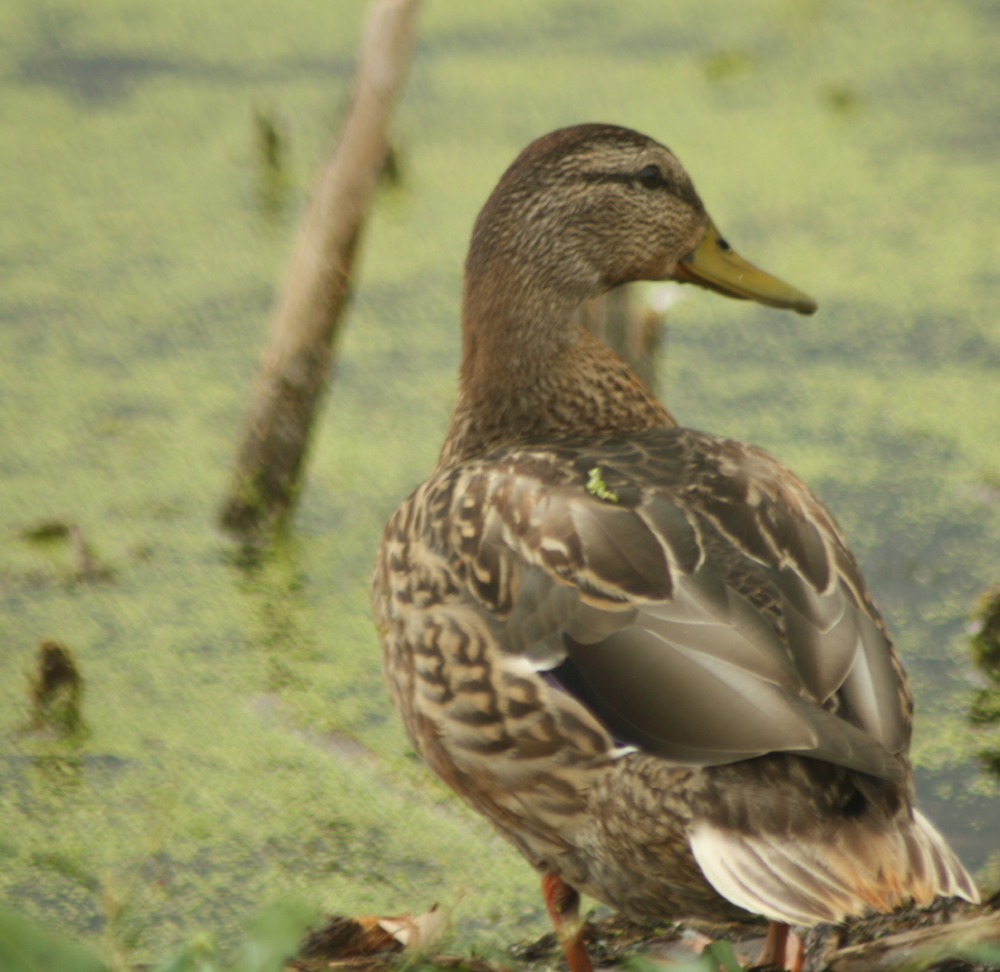
 The ducks in the three ponds were pretty calm - much calmer than, say, the kildeer. I was able to get up pretty close to this female mallard and then she turned to see what I was up to, which was nice of her. :)
Onto Every Chicory, A Little Rain Must Fall
I'm still quite fond of chicory plants.  I like the jagged edges of the petals and the stark black and white in the center.  As I mentioned back in the first post, it was raining off and on all day, which gave me this beautiful rain splattered flower.


Egret in Flight
 Okay, so getting good shots of birds on the ground or in a tree is still challenge for me, never mind me getting good ones of them in flight.  But this one doesn't suck.  I was even able to crop out the houses he was flying over.
Egret Reflects
 Another egret and reflection.  It was nice of him to stand where there was a patch of un-duckweeded water nearby. ;)
The Frog Remains the Same
 Remember in that other post I mentioned the frog that was sitting by the bridge as I passed by... and was still there, like, two hours later when I came by again?  Here is on my second pass.  I could see him breathing and his eyes are open, so, you know... not dead... but not active either.  On this shot I could see his little froggy toes turned in under his chin.
Tall Heron
 A Great Blue Heron being as tall as he could possibly be on top of a muskrat lodge.
Heart-Shaped Red Admiral
 A Red Admiral on white flowers.    I like that in this shot he's heart-shaped.
Goldenrod and Honeybee
A honeybee on goldenrod.  I can count his stripes. :)


A Pack of Quackers
Like I said, the place was thick with ducks.


Okay, one more post and I'll be done with this trip.  Is it bad that I'm kind of hoping for a week or two of crap weather?  I need some time to catch up!  As it is, it's October in Chicago and it's going to be 80 degrees today and 84 tomorrow.  I think I'm going to need to go out and shoot some more while I can.  Which, you know, is not helping in the "catching up" department.

Sunday, October 3, 2010

Rollins Savanna - 9.20.10 - Post 2

Okay, picking up where I left off with Rollins Savanna.

Patterned Feathers
Because I ended up hiking counter-clockwise, I found the area I was looking for sooner than I expected.  Which was a good thing, as the animals were already starting to settle in for the evening.  This duck was eating the duckweed (go figure).  I adore the patterns in his feathers.

Duck in Bubbles
There were a lot of ducks out there from a couple of different species.  This female mallard was in the middle of a ring of bubbles.  I'm not sure what was making the bubbles (I don't think it was the duck ;), but it makes for an interesting shot. :)

Egret in the Grasses
Okay, so my parents live in Florida and they call these things "Florida Chickens" - they're kind of ubiquitous down there.  But in Northern Illinois they're a little more rare. (Did I mention this before?  As I type that I'm having deja vu.) And I was kind of keen on how you can barely see the water, and the egret is such a small part of the picture.
Watching Lunch
I was able to sneak up a little closer as he was looking for food in the pond.  I love the shapes they can make with their necks.
Egret Reflects
This was as close as I could get on the bridge.  Another reflection shot.  Yes, I'm unusually enamored of those lately.
Frog from Behind
As I came around the path and onto the bridge over the second pond, I found this frog.  I have no idea what he's sitting on, but you can see that he's, essentially, not in the water.  And while I was able to see him breathing, he was otherwise very, very still.  I walked up to him, and past him.  And then about an hour later I circled around and he was *still* there.
Can I Help You?
I can't get the color on this one to correct the way I want it too.  I've discovered that the white balance - even the auto-WB setting on my camera is great when I'm shooting in Aperture or Shutter Speed modes, but when I use the auto-settings, like 'sports-mode' or 'portrait', the shots come out much too blue.
Eyes and Ears and Froggy Toes
I think this is from my second pass.  Still just sitting there.  Talk about a great shot of a frog's ear.  Check out how prominent that tympanic membrane is.
Kildeer on Muskrat Lodge
Again with the color correction issues.  Partly it's saturation, partly it's white balance, and I haven't yet completely figured out how to fix that in my post-production software.  Anyway, another new species.  Kildeer!  Talk about skittish birds!  This was as close as I could get, and I spent quite a while trying.  I'd always heard that there were Kildeer in Northern Illinois, but I'd never seen one before these.  They're sitting on muskrat lodges.  I checked repeatedly and moved very slowly, but despite the *large* numbers of lodges (another casualty of kids not being able to handle language - we would have called these dams when I was a kid) and the large number of birds I saw on them, I didn't see one muskrat all day.

Muskrat Casa Es Mi Casa
Speeking of Birds on a Lodge... here's a duck making herself very comfortable.
Sunflowers Stretch into Fall
A few flowers were holding on even though fall was seriously starting to settle in.  These little sunflowers were a nice spot of bright yellow on a gray day.
Dam Lodge
Here's one of the lodges.  Don't get the idea that they've been there for a while, but there's greenery and flowers growing on top of most of them.  I want to head back in the spring, because I would imagine they make great nesting spots for breeding ducks.

Okay... there's more, but I think I actually have more than ten shots in this post, so I'll wrap this post here.