Showing posts with label dragonfly. Show all posts

Monday, December 24, 2012

Wildlife at the Octagon - 10.07.12 - Post 2

So I can see that with 2012 winding down in a little over a week, I'm going to have to do massive amounts of editing and posting if I want to make my 100 species mark.  I'll try, but... it's not looking likely. :)  I'm pretty sure I've *seen* 100 different species, but getting them shot, cropped, edited and documented is another matter entirely.

But I'm going to try. ;)

Here are the critters that were not permanent residents of the Octagon, but were hanging out nonetheless. :)

Band-Winged Dragonlet Dragonfly (059 - 2012)
This is one of the larger dragonlet dragonflies.  It's a Band-Winged Dragonlet.  It's almost as big as the pondhawks, and has the same sexual dimorphism.  This is a male.


Now here's something I definitely won't be seeing here in Illinois.


It's a Southern Black Racer, and racing it was!  It was moving parallel to us as we walked, mostly by weaving itself in and out of the wires on the fence.  Unfortunately by the time I realized what it was, I was coming down from the fence.

Southern Black Racer (060 - 2012)
But then it ended up coming right at me.

Very, very good thing this guy is harmless.  My "this could puncture me, I should flee" instinct still isn't very solid.  I think I jumped when I first saw it, but then it was, "ooh, I need to chase it and get pictures!"


Turkey Vulture (061 - 2012)
Another guy who's pretty endemic in Florida - the turkey vulture.  Not what anyone would call a 'pretty birdie'.  They're scavengers and huge and just... not the friendliest thing ever.

Saturday, October 13, 2012

Corkscrew Swamp - 10.7.12 - Post 4

OkayI think this is the last group of true insects for this trip.  I have some spider shots to do soon, but as we all know, spiders aren't insects.

Ruddy Daggerwing Butterfly (052 - 2012)
This is a Ruddy Daggerwing.  And it was ruddy difficult to Google!  This is probably due to the fact that when you Google "orange butterfly with black lines" you get Monarchs up the ying-yang.  It's not helped by the fact that this particular species has a pretty small habitat so there just aren't a lot of pictures of them or articles about them out there compared to the Monarch or Red Admiral or a Sulphur, which are everywhere and much easier to find on the net.  South Florida and the Florida Keys seem to be about their whole range.  So, totally one I wouldn't be able to get up here in Chicago!


Paper Wasp (053 - 2012)
I'm still waiting for my "That can puncture you; you should FLEE" response to return.  Instead, when I saw this, I was all, "Oh look!  A *brown* wasp!"  We have yellow-jackets-o-plenty up here, but this was new.  It's one of the 22 types of Paper Wasps we have in the US. Anyone care to tell me which wasp I witnessed? :)


Female Yellow Dasher

Remember the blue dragonfly in the last post?  Here's his girlfriend.  Well, I don't know if it was *his* girlfriend, but this is the female of that species.  I called attention to the yellow spot on the male Blue Dasher's abdomen... the female takes that to the extreme.  She's pretty much all yellow.  And as you can see, she was pretty mellow. :)

Wednesday, October 10, 2012

Corkscrew Swamp - 10.07.12 - Post 3

Okay, now that the dolphin detour is over, I can get back to Corkscrew Swamp.

Hickory Tussock Moth Caterpillar (050 - 2012)
Near as I can figure, this is a Hickory Tussock Moth Caterpillar.  It's a lot like the White-Marked Tussock that I showed the other day.  Obviously, this one is white and the 'hair' patterns are different, but the over-all effect is pretty similar.
Here's another one.  Like the White-Marked, these caterpillars tended to travel in herds and also they can do you some damage if you think "oh cute, little fuzzy guy!" and try to pet him.
I thought this is a plain old Eastern Pondhawk, of which we have a ton in Chicago.  But it was awfully small, so I dug a little deeper and it turns out that it's a Blue Dasher.  You can tell by the yellow on the thorax and the lower part of the abdomen.
Phaon Crescent Butterfly (051 - 2012)


There are a truly ridiculous number of small orange and brown/black butterflies in the world.  Best I can figure this is a Phaon Crescent.  It's about an inch and a half across, when the wings are spred, it has white antennae with black tips.  (If I've got this wrong, feel free to correct me. :)


I didn't realize how many bugs I had from this trip.  So... more insects tomorrow. :)


Monday, October 8, 2012

Corkscrew Swamp - 10.7.12 - Post 2

The Bugs of Corkscrew Swamp.

I got a start yesterday with some of the bugs I saw, so I figured that I'd wrap up with them first.

Swamp Darner Dragonfly (047 - 2012)
So here's a dragonfly you don't see in Chicago.  It's a Swamp Darner.  And while Chicago was built on a swamp, we definitely don't qualify as one now.  I hate that this shot is backlit.  Normally when I shoot, I get half a dozen frames or so at time to try and get one without shake or in order to try getting the light at a different angle. This is the *only* frame I got of this guy.  So it's clear, but horrible lighting.  Blergh.

Palamedes Swallowtail (048 - 2012)
This is a cool find for me.  It's a Palamedes Swallowtail Butterfly.  It looks a bit like the Giant or even the Tiger's black morph, but there's no blue and no bar across the middle of the wings.  This butterfly has a pretty narrow habitat band going from the Gulf coast areas of Texas around Florida and up to about West Virginia (seasonally, further south more often).  So I won't find these at home!
 

Queen Butterflies (049 - 2012)
These are Queen Butterflies.  We found tons of these guys clustered up at one point of the trail.  Probably fifty of them all together.  And a lot of them were very interested in this dead plant you see in the picture.  These are the three that stayed after we accidentally spooked several more off of it.  I cannot imagine what brought all these butterflies to a dead plant.


Okay!  Three more bugs tomorrow! :)

Wednesday, June 22, 2011

Something's Bugging Me about This Post - Willowbrook WC - 6.16.11, post 1

So I mentioned in my last post that I was heading off to Willowbrook Wildlife Center again, this time as part of a volunteer work crew.  It was a great experience, and the brief walk I took through the center afterwards yielded a lot of great shots, but first I received some bad news.

My grebe died.  They said that at first he seemed to be doing well and eating on his own, but about a month after he was brought in something compromised his lungs and they were unable to save him.  I know they did everything they could; they're a remarkable facility, but I'm still kind of bummed.

Anyway, there were five people on our work crew and our job was to clear out a couple of invasive species in a section of the prairie.  We were pulling out Honeysuckle and Buckthorn and there was a *ton* of it.  In three hours we cleared about one-hundred square feet.  That doesn't sound like a lot for fifteen man-hours, but it was hot and the work was pretty intense.  We made a roughly ten feet deep, by six feet wide by six feet tall pile of brush to be burned.

There were some phenomenal insects and spiders unearthed in doing this, and the best way to get them at the time was to shoot them on my phone, so I did.  Of course the very next day, before I'd had a chance to move any of the shots, my card corrupted and I lost the pictures.  Oh well.

It was about 85* F out there and we'd been working pretty hard (and dragging up All The Pollen Ever!) and I was in jeans and work boots, so I didn't stay too long to get pictures afterwards.  I walked around the pond as far as I could go (they have a section blocked off) and did a bit on the trails.  But even in the hour and a half or so I was out there, there was a lot of cold-blooded critter activity.

In fact, I'm going from pretty much an all-bird blog, to an all-bug blog!  Mostly, but not entirely.  Well, entirely for this post.

This shot was an accident.  I was actually trying to get the wildflower and the bee flew in.  It's a bumblebee, of that I'm sure.  ProjectNoah tells me it's a Megachilid bee, probably Osmia.

This is a Six-Spotted Tiger Beetle.  He's an amazing iridescent green with a white face.  He's pretty small, maybe two centimeters long?


 Tiny dragonfly is tiny!  This is a Calico Pennant.  Lovely little bug with little hearts on their tails.  But small, for dragonflies. I'd say their bodies are between 1/3 and 1/2 the size of the 'normal' dragonflies I usually see like the Pondhawks or Saddlebags.


And for this particular day, they were also the most calm and easiest to shoot.


I have to say, these are the most ironic dragonflies for me.  They're called "Common Whitetails", but I rarely see them.  I saw one a the North Pond last year and there was only a few of them here.  Not so common!
Okay, photographically lously, but at least you can see the White when it's all spread out.  The big splotches on the wings and the light body make them pretty easy to recognize, even in flight.

This is a very small grasshopper, only 3 or 4 cm long.  I'm still trying to find out what kind he is.  Anyone have an idea?
A new dragonfly!  This is a Jade Clubtail.  They're significantly different than the other green dragonflies I've seen before.  I knew right away that this was something new.


They like to perch on the lily pads which is unusual.  If you look through most of my dragonfly shots, you'll notice that they usually like to land on sticks, reeds and grasses that are sticking up out of the water.


I believe this is an Eastern Comma.  It's a Comma of some sort, but because I couldn't get a good shot of her with her wings open, I'm not one-hundred percent sure which one it is.


This was the best shot I could get of the tops of the wings.  Not much help.


Okay, that's eleven shots.  Enough for one post.  More bugs and a few other critters and plants, later.

So let's see... the comma, the jade, the calico, and the tiger beetle.  Four new named species.  39 total of my 50.

Monday, June 6, 2011

Lincoln Park Ponds, more new species - May 31, 2011

Wow, haven't posted in almost two weeks.  Sorry about that.  It's not that I haven't been out shooting, I just haven't had time to get a post together.

That and the fact that I'm completely obsessed with ProjectNoah.com.  It's a fantastic site to talk to people who do a lot of what I do here.

Anyway, on Memorial Day, May 31, I hiked all three ponds on one of the very first 90 degree (F) we had this year.  The weather has been very slow to warm up which has kept the cold-bloodeds in hiding for a long, long time.  They're *just* making their way out now, as the migratory birds (the warblers and some of the finches, etc...) make their way up and out of the city.

Sign of Summer
 One of my favorite signs of summer.  The dragonflies are back!  We don't have the clouds of them (okay, that may be a bit of an exaggeration) that we had around this time last year, but slowly but surely, a few species are parking themselves somewhere easy to photograph.
Bowing Carolina


  I'll need to go back and check my posts from last year, but I think I was identifying all the bright red dragonflies like this as Red Saddlebags, but while checking this a few dozen times before putting it up on Project Noah (I *love* that people there will correct you if you get a spotting wrong, but I'd prefer to get it right myself the first time if I can.)  Anyway, it turns out that this is, in fact, a Carolina Saddlebags.  You can tell because a Red has these clear patches on their wings right where they attach to the body.  This one is red to the abdomen, so it's a Carolina.  Another tell is that the last couple segments on the Carolina are dark brown or black.  They're the same red as the rest of the tail on the Red Saddlebags.

First Spotting of a Twelve Spotted
 Like last year, one of the first dragonflies and easiest to identify is the Twelve-Spotted Skimmer.  This guy would perch for about eight seconds, I'd get a few shots and then he'd fly off in about a ten foot radius circle and then come right back to this stick and perch again before starting the process all over.  Made it easy to shoot him.  I just had to wait a few seconds everytime he left, since I could depend on him to come back. :)

Red Ears with Their Eyes on Me
 Another one I've learned better about.  Last year I thought all the turtles in the North Pond were Red-Eared Sliders. Turns out a lot of them were Eastern Painted.  So when I learned that, I started thinking that maybe I was just getting them all wrong and they were all Painteds.  But no.  Here are some honest-to-goodness Red-Ears.  In this case you have a male (the smaller) and the female (the larger).
A Bee on a Bud


The bees are making their way out too.  Here's a honey bee checking out the early goldenrod.


And about the time the bees come out, the wasps come with them.  Clearly my "this can puncture me and I should flee" instinct didn't recover over the winter.  I'm still trying to figure out which kind of wasp he is.  Any ideas?

Okay, so this guy clearly isn't cold-blooded, but I was really chuffed over this sequence of shots I got of him coming in for a landing.


I would have loved for that last shot to have been a little clearer, but he landed pretty far back. It's still a fun series of shots, though.  Night Herons are about as exotic as we get out here.

The Carolina Saddlebag and the Red-Eared Sliders (properly identified) are my only new species for this post, but that brings my total up to 35 of my 50 new species.


Wednesday, May 18, 2011

Last New Species post for North Pond - 5.10.10

So I thought I was done with new species for this trip, but then I started going through the shots I'd oh-so-cleverly labeled things like "CheckThisBird" and "UnknownSparrow".

 The first thing I found was this dragonfly wheel.  Unlike the pondhawks I had a ton of last year, this is apparently a Common Green Darner.  He's different because instead of having a solid, dusty, light blue tail, he has a darker green tail with brown marks on it.  He's also *huge*.
 After a few hundred painted turtles, I finally found something a little different.  This is apparently a False Map Turtle.  According to Wikipedia, When with other turtles, they also are very communal, sharing space and using each other for predator watching, increasing the odds of surviving an attack by any unwanted animal. Which explains why every time I saw one of these, they were hanging out with the bigger, more obvious, painted turtles. :)

Like this:

 A False Map hanging out with a group of Sliders.
 Not a new species, but in case you haven't noticed, I find sexual dimorphism fascinating.  This is the female Common Yellow-throat Warbler.
 The folks at the fabulous Project Noah site had to help me with this one.  Turns out he's a Lincoln's Sparrow.  They migrate through Chicago, but apparently don't stay.  So I was lucky to catch him as he passed through town.
 Here you can see his identifying head stripes a little bit better.
 This one is still throwing us for a loop at Project Noah.  He's a wren.  We know that much.  The white eyestripe makes me think he's a Carolina Wren.  But the Carolina Wrens have a very white chin, and this guy doesn't seem to have that.  The Marsh Wren is similar in coloring, but doesn't have the white eyestripe.  Any suggestions gratefully accepted! :)
 Another view, in case it helps. :)

 Something else that needs an I.D.  It's a beetle.  It was digging around in the bark chips on the path of the North Pond.  Any ideas?


Okay, so, I'm not entirely sure what they all *are*, but there's five new species in this post.  So now I'm at 28 of my 50, and the butterflies and dragonflies and most of the cold-bloodeds haven't really started making an appearance yet.  I may have to up my goal. :)

Saturday, September 18, 2010

Volo Bog - 9.04.10 - Post 4

Continuing on with Volo Bog...

Goldenrod Dragon
Goldenrod is pretty much everywhere in Northern Illinois wildlife areas.  This particular branch caught my eye, because it looks very much like a dragon to me.  I am the sort of person who likes to anthropomorphize this sort of thing, sure, but this just looked cool to me.
Still Blooming - Better Late Than Never
New flower!  Great Blue Lobelia.  The sharp folds and points in the flower petals make them stand out.
'Phyll-less Flower
I was sure these were mushrooms or some other sort of fungus when I found them, but while looking up something else entirely, I discovered that they are, in fact, a plant - the Indian Pipe.  Very weirdly for a plant, this plant obviously has no chlorophyll (the stuff that makes plants green); instead it gets its energy from being a parasite of the trees it grows under.  It's also called the Ghost Plant or Corpse Plant.  Creepy, eh?


Turning Red for the Winter
I'm pretty sure these are Winterberries, ripening from their initial pink into the bright red that will stay with them through the winter.


Two Sacks of Gold
Another bee on yet another flower.  But I like this one because you can see the pollen sacks on both legs in this case.  And he's still busily gathering.  I also really like how clearly you can see the joints in that front right leg.


Stripes on the Eastern Tailed Blue
I really hate that it was so windy the day I went up there.    This shot would have been so much better if the grass hadn't been getting blown to Kingdom Come.  Of course, if this Eastern Tail wasn't worried about getting blown into the next zip code, he might not have sat still at all.  It's not a great shot, but you can see the stripes on his antennae and on his legs.


White Face, Red Body, Green Weeds
Another White-Faced Meadowhhawk, with his White Face being very obvious. :)


Hairy Skipper
I was just inches away from this Fiery Skipper.  What a hairy little butterfly!


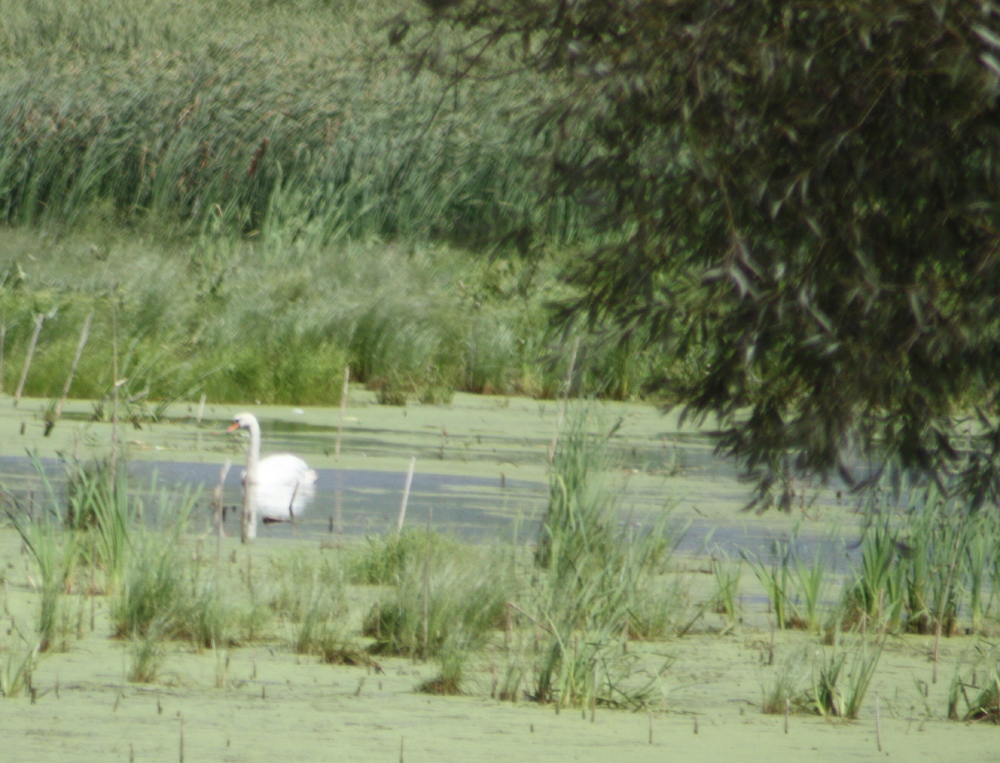
Wild Swan, All Bogged Down
Now this was one of the coolest things about being on the observation deck I was talking about in the last post.  I never did see the swans from the ground (there were two, but one was in and out of the rushes so much I never did catch him.)  If you look at the prairie grasses in the back, you can see how windy it was as I was shooting.  But hey, wild swans in Illinois!  I had no idea we had wild swans.


Spotted Jewelweed Hanging Out

This is a Jewelweed flower - Specifically, the Spotted Jewelweed.  Also called a Touch-Me-Not because the seed pods (not pictured) tend to explode when touched - not because it's hazardous for you to touch them.  In fact these plants are used as a common cure for the itch of poison ivy and other skin irritations.


Okay, one more card of pictures to go through for this trip. :)