Yesterday I posted the orchids. In the next room were the hibiscus. No matter how many times I see hibiscus flowers, I'm always amazed at how huge and how fleeting they are.
I love the pistil/anther/stamen organization of a hibiscus. So organized all on one stalk with such huge flowers around it. I'd love to see what kind of animal pollinates something this big. One of the plants we were shown on the tour had flowers so big that it required bats to fertilize them.
Look at the way the color palate is so similar, but the individual colors are so different. White stamen here, pink ones above. A pink center here, a purple one above. Both have red anthers.
The there was this guy. So huge. So frilly and different than the other two. Well, still with the red anthers, but very different in most other respects. And so big it filled up my lens.
So normally when I'm in a flower garden, I'm focused almost exclusively on the flowers, on the colors, on what pops the most. But on this trip I started to really look at the textures and designs in some of the leaves. This is called a "Ctenanthe" - I have no idea how that's pronounced. It looks like someone painted a plant into each leaf.
These are the leaves of a Peacock Plant. The pattern does remind me of the pattern in a peacock's feathers when he opens them. Again, there's a whole plant design in each leaf.
Ever do plant rubbings at camp as a kid? I did. This plant looks like someone put a fern under the leaf and then did a rubbing causing the fern impression to turn those parts of the big leaf dark green. This is a Silver Belle.
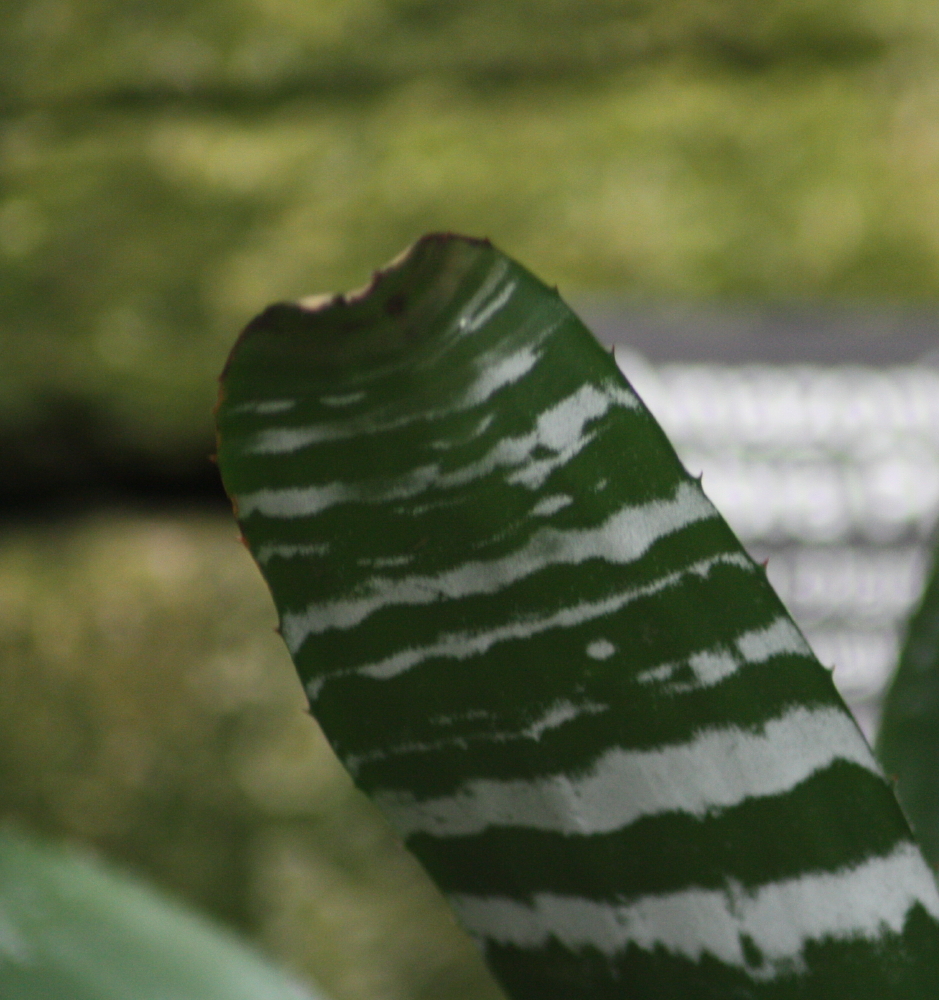
I found myself pretty amazed by this texture. It's a macro of the edge of a leaf of a Bengal Lily. The leaves were huge, but I focused on where this one bent a little because I just loved the stripes and ribbing.
Speaking of stripes and texture, this is a Rainbow Frangipani. Like the orchids, the leaves aren't near the flowers, so you don't get distracted when looking at the flower. This one was too high for me to shoot down the center of it, but it did have really lovely stripes of yellow, orange, pink and red.
Then there's the 'just plain unusual'. This is Beehive Ginger. I suppose the origin of the name is a little obvious. :)
Not that I was working strictly alphabetical through this post, but we're ending with a Zebra Plant. I was so focused on the fascinating red and yellow stripes in the flowers...
... that someone had to point out to me that there were also stripes in the leaves.
Okay, I'll have one more post on the LPC a little later, then I head back outside to the lilypond and the North Pond.
First and foremost this is a photography blog. A place for me to share my photos and discuss technique, but please don't be surprised at the occasional off-topic post. Obviously this blog will be photo-intensive. If you have a slow internet connection, please be patient. Shooting Down the Middle of the Road is aimed at the Journey-person level photographer.
Monday, August 23, 2010
Sunday, August 22, 2010
Lincoln Park Conservatory - 8.21.10 - Post 1
So yesterday I went to the Lincoln Park Conservatory with a group I belong to, and we decided to take the free tour. I've been there a half-dozen times, but I've never taken the tour. Note to self: when you can, take the free tour. You learn a lot and see things you might overlook.
This post is on the orchid room. I've spent plenty of time in the orchid room, but I've never noticed this one before.
It's called a Black Orchid for obvious reasons. I've seen a number of plants that are called 'black' before. Most of them are either a very dark green or purple. This was actually black. It looks like there's a spider in there or something.
Here's a close up of the black bit. I love the stripes at the top and the two 'fangs' at the bottom.
I chose this shot because I like the composition. There's this slash of bright pink across the muted background.
This is called a Moth Orchid because the petals look like a moth.
The tour told us there were over 5000 species of orchids and that people are constantly creating new hybrids. This is one of the hybrids. Very flashy and frilly.
Another color of moth orchids. These grow in denser groups on the stems.
This is a Lady Slipper Orchid. I think you can see why. :)
Here's the whole lady. :) I didn't catch the name of this particular species, but they always remind me of a woman in Victorian dress.
One of the things I like about orchids is that they grow on stems that don't have leaves 'cluttering up' the view of the flower.
So you can get some really great close ups of the flower without having to touch or move or tuck away things you aren't interested in.
Okay, that's it for the orchid room. I'll get the hibiscuses (hibiscii?) and others up later. :)
This post is on the orchid room. I've spent plenty of time in the orchid room, but I've never noticed this one before.
![]() |
| Black Orchid |
![]() |
| Creepy Orchid Up Close |
![]() |
| Slash of Color |
I chose this shot because I like the composition. There's this slash of bright pink across the muted background.
![]() |
| When is a Moth Not an Insect? |
This is called a Moth Orchid because the petals look like a moth.
![]() |
| Frilly and Purple |
The tour told us there were over 5000 species of orchids and that people are constantly creating new hybrids. This is one of the hybrids. Very flashy and frilly.
![]() |
| Stems of Pink Moth Orchids |
Another color of moth orchids. These grow in denser groups on the stems.
![]() |
| Lady-Slipper Orchid |
This is a Lady Slipper Orchid. I think you can see why. :)
![]() | |
| Flower Wearing a Dress |
Here's the whole lady. :) I didn't catch the name of this particular species, but they always remind me of a woman in Victorian dress.
![]() |
| A Dash of Purple on White |
![]() |
| Tie-Dye Is Back In |
So you can get some really great close ups of the flower without having to touch or move or tuck away things you aren't interested in.
Okay, that's it for the orchid room. I'll get the hibiscuses (hibiscii?) and others up later. :)
Saturday, August 21, 2010
South Pond - 8.18.10 - Post 2 (The Birds, the Bees and the Fishies)
Okay, last set of shots from Wednesday, so that I can start going through my shots from today, before I got out again tomorrow. :)
A wasp on a flower. At this size it's a little harder to see, but the stripes on his abdomen are almost green.
I may have mentioned this before, but photography has completely wiped out my sense of self-preservation when it comes to things that could puncture me. (And that's just so wrong, given my huge phobia of needles and such). But I no longer go, "Look, a wasp! I should move away." I go, "Look a wasp! Hey sit still so I can get closer and get a nice clean shot!" This is going to bite me in the ... uh... arm? eventually, isn't it?
I love that the bee's body is still and reasonably in focus in here, but his wings are moving far too fast for my shutter. And when I'm outside on a nice day, I'm shooting pretty fast. This particular shot was at 1/400. That means this bee flaps his wings faster than 400 times a second! I also caught him with his 'tongue' sticking out. :)
Remember what I was saying about not having the sense to run the other direction in the face of puncturables? I spent a good three minutes getting this thread-waist wasp. Doesn't he look like he came shipped in two pieces? I love the shadows in this one. There's the shadow of his antennae and the fact that the upper-left corner leg is bent, but the sun is straight over it, so the shadow is straight. And that stinger... I really need to start being afraid again.
Here's another juvenile heron. I guess they're getting big enough to fish for themselves now.
This goose looks like he's freaking out over something, but he was fine. A kid had tossed his apple core into the pond and the goose snapped it up. He'd gotten it bitten into manageable pieces and was working on choking them down before anyone else could grab them.
A wood duck. Where I grew up we had Canadian Geese and Mallard Ducks o'plenty. But that was pretty much it for waterfowl. So I'm loving the fact that Chicago has a population of different ducks, like wood ducks. This happens to be a juvenile male. Juvenile males are colored more closely to and adult female, but they have a white neck patch (easy to see in this shot). Adult males have red beaks, females have gray beaks. All juveniles have gray beaks. In this shot you can see where his beak is losing the gray and coming in red.
The water was incredibly clear. This looks like an overhead of a forest shot from a plane. It's the algae plumes coming up from the bottom and not reaching the top. Everything in the shot is under the surface of the water.
A little further around the pond, the algae is a little browner and there are tons of fish in it. Occasionally I'd see a Blue Gill, but they were jittery and would take off before I could get a shot. There were tons of these clear guys though. I think they may be X-Ray Tetras. Which I do find kind of funny if they are, since I drove all the way up to Niles to take pictures of X-Ray Tetras in a pet store for my nephew's animal alphabet book.
More fish. I like how I caught the one on the far right side in-mid swerve.
Okay... now to sort the shots from the Lincoln Park Conservatory, the Lily Pond and the east side of the North Pond. (It was a busy day today.)
![]() |
| Wasp on Orange Flowers |
I may have mentioned this before, but photography has completely wiped out my sense of self-preservation when it comes to things that could puncture me. (And that's just so wrong, given my huge phobia of needles and such). But I no longer go, "Look, a wasp! I should move away." I go, "Look a wasp! Hey sit still so I can get closer and get a nice clean shot!" This is going to bite me in the ... uh... arm? eventually, isn't it?
![]() |
| Bee on the Wing |
![]() |
| There's Thin and Then There's This |
![]() |
| Little Heron Waits for Lunch |
![]() |
| Goose Gets to the Core of the Problem |
This goose looks like he's freaking out over something, but he was fine. A kid had tossed his apple core into the pond and the goose snapped it up. He'd gotten it bitten into manageable pieces and was working on choking them down before anyone else could grab them.
![]() |
| Wood Duck, Almost Grown |
![]() |
| Algae Forest |
![]() |
| Fish in Algae |
A little further around the pond, the algae is a little browner and there are tons of fish in it. Occasionally I'd see a Blue Gill, but they were jittery and would take off before I could get a shot. There were tons of these clear guys though. I think they may be X-Ray Tetras. Which I do find kind of funny if they are, since I drove all the way up to Niles to take pictures of X-Ray Tetras in a pet store for my nephew's animal alphabet book.
![]() |
| Fish in Mid-Swerve |
More fish. I like how I caught the one on the far right side in-mid swerve.
Okay... now to sort the shots from the Lincoln Park Conservatory, the Lily Pond and the east side of the North Pond. (It was a busy day today.)
Labels:
bee,
chicago,
duck,
fish,
goose,
heron,
new species,
photos,
south pond,
wasp
Friday, August 20, 2010
South Pond - 8.18.10 - Post 1
I had a few errands to run in Lincoln Park on Wednesday, so I left a little early and took a trip around the South Pond. I haven't been down there in three or four weeks, so there was a fair bit of change. It's a re-established ecosystem - they spent the last year draining the pond, redeveloping the bottom of it and relandscaping the entire thing and adding the elevated boardwalk (made not of boards, but recycled plastic bottles.)
So in a month a lot changes. A lot of the thinner grasses that were seeded have started coming in, a lot of the animal populations are starting to become accustomed to people and aren't hiding quite as much. The tadpoles have metamorphed.
Like this guy. He was sitting in the very shallow water at the end nearest the zoo, just hanging out. You can see where his eyes and nose are out of the water, but the rest of him remains completely submerged. I think he's a Green Frog (that's a species, not just a description), but the pictures I'm finding on line aren't *quite* the same. Anyone have any other guesses? The sign at the pond actually calls him a toad, but he's in the water and very smooth. Doesn't that categorize him as a frog?
[Frog in the Shallows]
This guy seems to be a Northern Leopard Frog. You can see his spots on his legs. Why does water have to be so shiny? This shot would be so much better without those reflective marks.
[Frog Floats]
There were two new dragonfly species being cooperative on this walk. I'm reasonably sure this is a female Calico Pennant. There's a chance it's a Prince Baskettail, but the resource I use for identifying dragonflies says the Baskettail rarely lands, and this one was still for a little while. The same resource shows a more red Pennant, but then says "the female has the same markings in more golden tones." So... I'm going with the Pennant unless someone has a better idea. [Calico: It's Not Just For Cats Anymore]
I love the name of this one! It's a Halloween Pennant. And according to its description, it sits on top of vegetation even on very windy days... so I'm pretty that's right. ;)
[Halloween Pennant in August]
She even flipped around to show me her face.
[Halloween Pennant Turns to Stare]
I so love this shot. I've had a hard time getting insect eyes in focus. This bee crawled right over the top of the flower to stare back at me. Not bad for hand-held, eh?
[Bug Eyes]
The Buckeyes were out in force. This one was basking on a blade of grass, showing off his false eyes.
[Buckeye on Grass]
This one was doing his 'butterfly thing' on top of a coneflower.
[Stopping for a Sip]
I was actually shooting something else when I caught this bee coming up to land on the flowers.
[Bee, Incoming]
Last shot for the post. This is a juvenile Black-Crowned Night Heron. A lot of the fledgling birds are starting to show this time of year. This one may have been fishing... or he may have just been admiring his reflection.
[Young Heron Reflects]
So in a month a lot changes. A lot of the thinner grasses that were seeded have started coming in, a lot of the animal populations are starting to become accustomed to people and aren't hiding quite as much. The tadpoles have metamorphed.
Like this guy. He was sitting in the very shallow water at the end nearest the zoo, just hanging out. You can see where his eyes and nose are out of the water, but the rest of him remains completely submerged. I think he's a Green Frog (that's a species, not just a description), but the pictures I'm finding on line aren't *quite* the same. Anyone have any other guesses? The sign at the pond actually calls him a toad, but he's in the water and very smooth. Doesn't that categorize him as a frog?
[Frog in the Shallows]
This guy seems to be a Northern Leopard Frog. You can see his spots on his legs. Why does water have to be so shiny? This shot would be so much better without those reflective marks.
[Frog Floats]
There were two new dragonfly species being cooperative on this walk. I'm reasonably sure this is a female Calico Pennant. There's a chance it's a Prince Baskettail, but the resource I use for identifying dragonflies says the Baskettail rarely lands, and this one was still for a little while. The same resource shows a more red Pennant, but then says "the female has the same markings in more golden tones." So... I'm going with the Pennant unless someone has a better idea. [Calico: It's Not Just For Cats Anymore]I love the name of this one! It's a Halloween Pennant. And according to its description, it sits on top of vegetation even on very windy days... so I'm pretty that's right. ;)
[Halloween Pennant in August]
She even flipped around to show me her face.
[Halloween Pennant Turns to Stare]
I so love this shot. I've had a hard time getting insect eyes in focus. This bee crawled right over the top of the flower to stare back at me. Not bad for hand-held, eh?
[Bug Eyes]
The Buckeyes were out in force. This one was basking on a blade of grass, showing off his false eyes.
[Buckeye on Grass]
This one was doing his 'butterfly thing' on top of a coneflower.
[Stopping for a Sip]
I was actually shooting something else when I caught this bee coming up to land on the flowers.
[Bee, Incoming]
Last shot for the post. This is a juvenile Black-Crowned Night Heron. A lot of the fledgling birds are starting to show this time of year. This one may have been fishing... or he may have just been admiring his reflection.
[Young Heron Reflects]
Labels:
bee,
butterfly,
chicago,
coneflower,
dragonfly,
frog,
heron,
new species,
photos,
south pond
Thursday, August 19, 2010
Midewin - 8.15.10, Post 3 (last post for this trip)
Last batch from Midewin, which, if you're curious, is pronounced mih-DAY-win. I didn't know that until the emergency guy called me back and said it out loud.
Another swallowtail (who's missing a bit of her right wing 'tail'.) This is the underside of her wings. It's nice that on this particular species the underside and the topside are pretty similar. It makes identifying them much easier. Some species are so different when their wings are up than when their wings are down and most identification pages only show wings-down, so you're hoping and guessing as you try to assign a name to a critter. [Under the Swallowtail]
I love this shot. You have a great view of the body and the colors on the wings. You can see her antennae and her feet.
[Swallowtail in Profile]
These Pearl Crescents were out in droves and I loved how they seemed keen on doing that iconic 'butterfly on a flower' thing.
[Feeding Time for Pearl]
This ended up being lit poorly and not as in focus as I'd hoped, but I just love the composition. This little Pearl Crescent wanted so badly to become one with his flower!
[Becoming One with the Flower]
This poor guy actually has a species name of "Little Yellow Butterfly." No, really, that's what it's called. What's really hard to see in this shot unless you blow it up, is that he's sitting there, wings open, basking in the sun, and holding court with a bunch of the little purple butterflies, which I think are Acadian Hairstreaks. The easiest one to see is in the lower right corner, but they do a pretty good job of blending in and looking like a piece of rock.
[Little Yellow Butterfly Holds Court]
Wild Morning Glories. I love finding flowers that people plant "on purpose" out in the wild.
[Wild Morning Glories]
Pearl Crescent in the mud and sticks. Beautiful butterfly in a less than beautiful background. I like the contradiction.
[Pearl in the Rough]
Little tiny grasshopper! I believe it's a Red-Legged Grasshopper, but at some point I'll need to research this guy a little more.
[Grasshopper Faces Obstacle]
I cannot find a species name for this beetle. Anyone? I like the look of him isolated on the leaf with the blurred background.
[Shiny Red Wings]
This huge bush of Black Eyed Susans was found... in the parking lot of one of the sections I didn't explore. (I went over there, started to sign in and look for the trail, but I was already hot and tired, it was already 5:00 and the insects were so thick that I hung it up.)
[Serious Bunch of Black-Eyed Susans]
Labels:
beetle,
black eyed susan,
butterfly,
grasshopper,
illinois,
joliet,
midewin,
morning glory,
name this critter,
new species,
photos
Midewin - 8.15.10, Post 2
I found this sign kind of interesting. Blow it up and read it if you can, but the short version is "There may be archeological and anthropological stuff on these grounds. Don't touch 'em."
Um... this used to be a MUNITIONS plant storage site. A.) If those are the A&A artifacts, I wouldn't want to touch them anyway. B.) If they aren't - if there's actual Native American or even colonial American stuff there - I'm really, really, really surprised the Army didn't deal with it when this was their land and I'm not sure I want it. I didn't see anything old and interesting.
A Carolina Grasshopper (Carolina Locust). These things are pretty huge for bugs. Maybe three inches long? And they fly as much as hop. When they do their wings give them a vaguely butterfly-ish appearance which kind of freaked me out when they landed in front of me and *weren't* butterflies. They also look like pieces of wood lying on the path, until you step near them. Then they jump up and fly in your face, which is rather shocking.
[Carolina in Central Illinois]
I'm pretty sure this is a Silver-Spotted Skipper. A type of butterfly I hadn't seen before.
[Silver-Spotted Skipper Sips]
So yesterday I posted a little about the butterfly watering hole. This is a piece of one shot, where you can see how thick the butterflies got over there.
[Crowd of Cloudeds]
Okay, this shot is *lousy*, even this small, but it's a red-tailed hawk. I saw several circling around the meadow.
I *think* this is a Citrine-Tail Damselfly. I know it's not the sharpest shot ever, but it's a very small critter - too small to be a dragonfly. And the only all yellow-tail damselfly I can find online is the Citrine-Tail. If anyone has any better ideas, I'd love to hear them.
[Vibrating Citrine-Tail]
I believe this is a Pearl Crescent. I love in this shot how he seems to be sitting on the tip of the shadow the same way butterflies sit on the tops of flowers and grasses. These are teeny tiny guys - about 1 or 1.5 inches across.
[Perched on the Edge of a Shadow]
A White-Faced Meadowhawk. Probably one of the calmest dragonflies ever. This guy was pretty far back from the path so he was harder to shoot than I would have liked. In some ways it was good that I didn't schlep my tripod, but it would have made this shot much better.
[White-Faced Watcher]
Two Dogbane Leaf Beetles. Gotta love the internet, because seriously, who learns about "Dogbane Leaf Beetles" in school and can identify them like you can, "Oh, that's an ant/bee/fly." I think we need to change the old expression to "The birds and the bees and the beetles" if you know what I mean. ;)
[Beetles: Like the Birds and the Bees]
Okay, that's ten. More later. :)
Labels:
beetle,
butterfly,
damselfly,
dragonfly,
grasshopper,
illinois,
joliet,
midewin,
new species,
photos,
sign
Subscribe to:
Posts (Atom)