Monday, May 9, 2011

More new species - North Pond and Magic Hedge - May 1 and May 7, 2011

Okay, so I'm on my way to my 50 new species for the year.  Here's a few more I caught this week.  This is the rest of the batch from the last post at the North Pond and a few I've spent a few hours researching that I've found at the Magic Hedge.

We'll start with Warblers Are Us!


 Okay, this took way more research than you would think.  But our first warbler making his way through Chicago during the migration season is a Yellow-Rumped Warbler.  Funny, I don't see yellow on his rump, just on his wings... but I'm pretty sure this is right.

I need to go back and really work to get a good shot of one of these; they really are pretty.  Yellow Warbler (kind of obvious, that one, yeah?)

From the warbler family, an Ovenbird.  I have absolutely no idea how it got that name.
 A better look at the bright spot on his head.  He was actually a very cooperative little guy, hopping around on the floor of the forest, but out in the open so I could see him for quite a while.
 From pretty decent shots, to absolutely awful shots, this is an American Redstart.  It's also part of the warbler family.  I'm not even sure I'd be able to identify this guy from this shot, but there was a bird-watcher out there who identified him for me.
This was the best view he'd give me for more than half-a-second.  The good news is, when I was researching them, they mentioned how the Redstarts like to show off their tail feathers quite a bit, so it helped me to know that, yes, this was what I was dealing with.


And just for comparison sake, a bird I actually counted as new in the last post. This is a female Eastern Towhee. Noticeably browner than the...
... male Eastern Towhee.  Sexual dimorphism, they have it. :)


So, that's 4 new species, to go along with the 10 from the last post.  14 new species for 2011 so far!

Wednesday, May 4, 2011

North Pond - 5.01.11 - Post 1 - It's Like Living on the Avian Super-Highway

So Chicago is in the middle of a pretty significant migratory path and at this time of year we see all kinds of birds that don't hang out here year-round.  I'm told the Magic Hedge can see over 300 distinct species in a migration.

Now I was out quite a bit both last fall and last spring, but I'm certain I didn't even see 50 distinct species.  What that tells me is that I'm clearly not looking hard enough.  For example, it took until a particular walk out there last fall to realize that there were at least four distinct species of sparrows all over the place - the ones that were black and white, the ones with the yellow stripe on their heads, the ones with little red mohawks and the ones with the gray heads.  I obviously need to be more studious in my taxonomy.

So I've set myself a challenge for this year.  In the year 2011, I want to photograph fifty wild species that I did not show up on my blog in 2010.  For this particular challenge, I'm a little less worried about how stellar a given shot is - especially with birds, they rarely sit still where you can see them for the time I'd need to set up a tripod and change settings and all that.  I just want to show that I'm looking closer.  That I'm getting on the ground and looking for caterpillars and bugs.  That I'm learning the difference between a black-capped chickadee and a white-crowned sparrow.

So here are my first ten new bird species.  The North Pond was *spectacular* last weekend.  I felt a bit like Tippi Hedren there were so many birds flying around me.

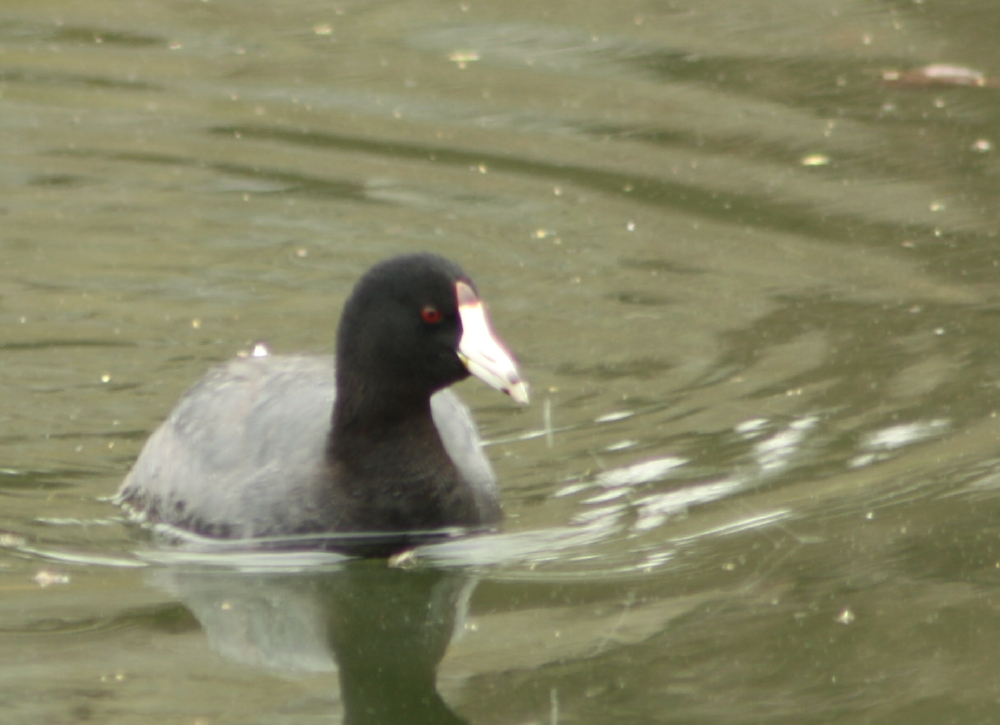
New Species #1: American Coot

This guy was adorable.  His head moved back and forth as his little legs carried him through the water.  He's about half the size of a Wood Duck - so this is one small waterfowl.  And he was out there by himself.  I didn't see another like him or a female that would appear to go along with this guy.
New Species #2: Brown Creeper

 
Last year I would have assumed this was some sort of sparrow.

Not even close.

It's a Brown Creeper.  It's like a nuthatch, only not.  A nuthatch goes head first down the tree when foraging for food.  Creepers spiral up.
New Species #3: Chipping Sparrow


Here's one of my "it's a sparrow" birds.  I never really looked much closer.  This one is distinctive because of his little red and gray 'mohawk' of feathers on top of his head.
New Species #4: Eastern Towhee


 At first I thought this was an oriole.  And I wasn't too far off.  He is in the same family.  The reddish brow patches on his sides really stand out when he flies.
New Species #5: Gray Catbird


To be fair I did *see* one of these last fall at the Hedge, but I couldn't figure out what it was.  I'm learning to ask the birders I see out with their binoculars if they've seen anything interesting.  If nothing else, it gives me a name or two to Google when I get back.  I also know of a great website that tells me what species are close to the one I'm looking up.  For example when I looked up "oriole" for the one above it said, "Similar species: towhee" so I knew to check that when oriole was clearly not right.

New Species #6: Greater White Fronted Geese

 Another set of animals I think I've seen before.  I'm pretty sure this pair of geese hangs out in the North Pond, or near it, year-round.  They aren't tagged as belonging to the nearby zoo, but they're the only two of their kind I've seen.  I have to say this: I like these guys a lot better than our 'garden variety' Chicago geese - those are Canada geese.  They stay in Chicago all year, despite their name,  and are mean as all get out.

New Species #7: Hermit Thrush

Something else I would have called "some kind of sparrow" and wouldn't even have been close about.
New Species #8 and #9: Barn Swallow and Tree Swallow


Two for the price of one!  Yeah, I know, it's an *awful* picture.  They were really, really at the limit of my telephoto lens.  I'm hoping to go back and actually get good pictures of them.  But they're swallows and it's amazing to find them sitting still for more than six seconds.  These were the guys that gave me the Alfred Hitchcock feeling. They were swooping around *all over*.

The one on the left is a Barn Swallow.  His buddy on the right is a Tree Swallow.  I don't think they hang out in Chicago for very long.  I don't remember seeing them at all last year and with the huge numbers we're seeing now, I'm pretty sure I would have seen a couple in the summer if they'd stayed.  So we appear to be a stop-over on the way to either Michigan's UP or Canada or something.

New Species #10: White-Crowned Sparrow
 So I was saying about the 'black and white headed' sparrows.  They're White-Crowned Sparrows and there seems to be tons of them this year.
 So that's ten to get started with.  I suspect it'll be easy to get the first 25 or so, but then I'll stall out when it's all "It's another chipping sparrow" or "Gee, look, another thrush."  I have a few more, but they'll go in the next post so I don't kill anyone's computer with too many pictures in a post.

Monday, May 2, 2011

I Think I've Photographed Everything That Moves in Chicago

So, I've been away for a bit.  I haven't left home, but my internet time got a little derailed by a few things.  Most notably I had a houseguest for the past 8 days.  She wanted to see Chicago.  Since I see Chicago through the lens of a camera, I took her to my favorite shooting grounds.  In a week we covered The South Pond, Lincoln Park Zoo, The Shedd Aquarium, The Field Museum, The North Pond, The Chicago Botanical Gardens and the Magic Hedge.  And right before that I went with a group to shoot "The Bean" and Buckingham Fountain downtown and went out to Willowbrook to retrieve the tripod I left out there.

I have roughly a million photos to deal with now.

Doing all this shooting in such a short time has made me think about a lot of things.  Chiefly about my workflow.  If you're unfamiliar with the term, workflow in photography is the system a photographer uses to get their pictures off the camera and in whatever final form they want them in.  In my case I want them ready to publish on this blog.  Other people want to get them printed or produced in books.  Whatever your final form is, the beautiful thing about digital photography is that you can take your raw image (not RAW image - I'm not talking about file format here) and edit it yourself and make the most of what your camera captured.  But after a few hours out with your digital camera you come home and find that you've literally taken 300+ images and... well, NOW what?

In my own workflow I tend to have one less-than-stellar habit.  I race home from any given shoot, move my shots to my harddrive and then go through and sort out the ones I want to at least look in in my editing program from the absolute garbage.

Unfortunately, sometimes I come to a screeching halt right there.  I have tons of shots I know are pretty good, but haven't been edited because I have the attention span of a damselfly. 

Ideally, my workflow would be something like this:

1.) Move the photos to the harddrive.
2.) Sort and label shots with some redeeming value from what I can see in the 'preview' function in the finder.
3.) Sort the decent shots into preliminary groups based on how I want to group them for posts here.
4.) Edit in batches.  Crop and correct color/lighting in each photo in a given group all at once.  This is where I should probably start reducing the number of 'useful' shots pretty judiciously. 
5.) Save both large versions and small (blog-sized) versions of edited shots.
6.) Blog each set once it's been edited.
7.) Back up photos onto a DVD.  I've lost all my shots from 2009 from a dropped external harddrive.  I really should be better about backing up the 1/2T of shots I have on the current external than I am.


I'm curious to know how other photographers handle large numbers of shots.  Back when I was a kid and shooting on film, we didn't have workflow. Not like this.  You took the 24 or 36 shots and then shipped the canister off the the drug store for developing.  If you had your own darkroom, like I did, you may have waited until you had a few rolls to develop so you didn't waste unstable chemicals, but even so, you weren't working with the extreme numbers of shots you can end up with after a week of digital shooting.

So the next oh... many posts will be my shots of spring *finally* deciding to come to Chicago.

Sunday, April 10, 2011

Grebe Expectations - Part 2 - Duck out of Water

So last Thursday I went out to check on the little rescued Grebe.  She (and I'm assigning a gender totally arbitrarily since grebes aren't gender dimorphic, and as the woman I interviewed explained, there was no medical reason to try and determine a gender to treat her) ended up at the Willowbrook Wildlife Center.

I called up to see if I could do a follow up on her and I was able to interview one of the rehabers named LuAnn.  Because they're a wildlife rescue and rehab first and foremost I wasn't able to see the grebe.  She's being treated, but they want her to have as little interaction with humans as possible to facilitate her re-release into the wild.

The vets did take a couple pictures which they were gracious enough to send to me.


I look at those back legs now and I completely understand why she couldn't get off the ground.  Those are not walking, let alone running, feet.  Those are clearly paddling feet.

(These two photos belong to the Center and are used with their gracious permission).

As I mentioned in the first post, she had a bit of a chunk taken out of her neck and required medical intervention, antibiotics and painkillers.

When I got out to DuPage County, LuAnn and I sat down to discuss the care this animal received and what people should do if they find an injured wild animal and a little bit about the Willowbrook Wildlife Center in general.

What did you do for the grebe?

The vet cleaned up his wounds, she gave him a check up this morning.  He's on pain meds and she put him on antibiotics.  A lot of what happens over the next few days is watching him, getting him to eat... we give him a variety of food in his water.  He has shallow water right now because of his wounds, so he can't go totally in water.

Can you tell what attacked him?

No.  We can't tell if he was attacked or if he got caught on something.  We don't usually know unless somebody sees what happened.

We found this bird flopping down the street and she obviously needed help, so we picked her up.  What ideally should people do when they find something like this?

She needed to get picked up, because she obviously had wounds and couldn't fly away.  I wouldn't have suggested anything different.  But the people need to be safe first.  She was in the road, so people need to be careful when trying to help.  A lot of times the first car can see what's going on, but then someone tries to get around the stopped car and doesn't realize what's happening.

Someone at the scene suggested we use a plastic bag, but I said that plastic wasn't a good idea because some animals may eat it, is that right?

We use paper bags a lot.  You could have a problem with suffocation with plastic.  The migration group uses paper bags.  They're inexpensive and if they put tissue on the bottom they can get some traction, if it stays clean then you can reuse it.

How common are grebes to this area?


Not all that common.  We might get two or three or four a year.  It's not like a mallard or something.

How many animals does your center treat?

It varies a lot.  We can get a couple hundred in one day during migration. Last year we had over 8000 for the year come in.

What percentage can be rehabbed?


Most centers will say about half - between 45 and 50 percent.  Though it depends on how they do their numbers. Some count the ones that are dead on arrival, others don't.  Most animals have so many strikes against them by the time someone can catch them...

Of that 50%, how many can you re-release into the wild?


Almost all of them.  We have about 90 or 95 permanent animals that stay here for education.  There are some that live on the grounds that people learn about them by seeing them, and some that go out for school programs - like a red-tailed hawk that has a wing injury and can't hunt.  We also have a relationship with Brookfield Zoo, the Shedd Aquarium and Lincoln Park Zoo and they have one with us as well.  Sometimes we can place animals in different places.  We have a reintroductory program for some animals where we collect and hatch the eggs to make sure raccoons and other animals don't get to them and then release the young animals when they can protect themselves.

What's the most exotic animal you've ever received?

We get in mink occasionally.  A couple years ago we had three young mink that we raised and released. There's a few animals where we only get a few in a year, and then we may not see them again for a couple of years. We rehab anything that's native to the area.  We don't do non-native species, we have referrals for those.  Sometimes we get a call that an animal has been confiscated at the airport and they need someone to take it.

Do you ever get maxed out?  Do you ever have to say, "I'm sorry, but we just don't have any more room?"

We have a limit on raccoons.  Our cage will only hold so many because they're territorial.  And there's a second breeding season later in the summer, so we'll start taking more then.  It's hard to say no, but if we take too many we risk introducing a lot of disease.


So after we talked, I walked through the permanent collection and then did a walk through the attached wild forest preserve.  I'll post about both of those under separate covers in the next day or two.

Thursday, April 7, 2011

Grebe Expectations - Part 1 - Get the Duck Out of Here!

I was down in Lakeview last night.  Lakeview is a trendy, very busy, northside neighborhood that's busy with both pedestrian and auto traffic, pretty much 24/7.  There are a lot of dogs - to the point where many of the businesses on the main drag - Broadway - have doggy water bowls out in the summer and leash stations near the door.  Not a good place for wildlife to take a detour.


I got off the bus and was heading up the block when I see what I think is a small duck floundering right in the middle of very busy Broadway. A guy runs up and uses his dog to flush it on to the sidewalk, but by the way it was flying/floundering/waddling, I could tell it was either very young or pretty hurt. So I ran up to help. Or at least see if I could help.

By the time I got there it was across the sidewalk and flopping down a 6-step stairwell. Once it was down there a local guy got it cornered. Someone suggested getting a plastic bag to contain it in, but I said that might not be a good idea because some animals tend to eat plastic when it's 'offered.' I said a towel would be better.  All of a sudden I'm the wildlife expert on the block.

So another bystander, who I later learned was named Maggie got a small blanket from her car while I called 311 (non-emergency city help line). As I was waiting another bystander, named Meg, said she was also on hold with them. I got through first and asked for an animal control call. They took my details and said they'd dispatch someone. In the mean time it was becoming apparent that this bird was less than thrilled with the blanket being over its face, so I took it from the guy who had it and uncovered its face and held on to it.

We'd thought it was a duck. As I was talking to 311 I told them it wasn't a Mallard or a Wood and I didn't recognize it. Then it stuck its neck up and I was all, "Oh hi there. You are not a duck!" My initial thought with its neck shape and beak shape was that it was a very juvenile heron. The webbed feet weren't quite right for a heron, but I'm not exactly the heron-master, so, you know two out of three heron features...

So we had a crowd for a while, but after about 15 minutes of waiting for animal control most people moved on, which left me, Meg, her boyfriend Justin and Maggie. Eventually Maggie got her car so we could sit and wait, but our little avian friend wasn't entirely thrilled with the OMG!INSIDE! of it all. After half an hour Meg called 311 back and the person she got said, "Oh, we don't do bird calls," but she gave us the number for bird rescue. Bird rescue told us to put the bird in a box and drive it over to the Peggy Notebaert Museum, which was all of about 5 minutes away. Then they called over because it just so happened that one of their bird rescuers was teaching a class at the closed museum last night and let her know we were coming with a rescue. So Meg's on the phone with Bird Rescue and we're trying to give an update. "We think it's a young heron. She's been injured, but she's alert and calm, but not lethargic." I was waiting for them to ask us if we could take her pulse or something.

So, since I'd taken the bus, and was apparently in charge of bird control, Maggie drove us over to the museum where we delivered her to Annette of the bird rescue group here in Chicago. On the way over we named her. Gracie Barry.

Why? Because we found her on Barry Street and Broadway. And Gracie the Grebe (once we found out she wasn't a heron) sounded good.

So we brought her in, and gave the box to Annette. Since being put in the box she had buried herself in the blanket and was being very still. We were a little worried there for a while. But she looked in and went "OH you found a grebe!" at which time Gracie perked up like someone had called her name.

We showed Annette where Gracie had been injured by another animal - she had a chunk of feathers missing out of her neck and a patch on her back, but she didn't seem to be bleeding profusely or anything. Annette said she'd take care of her and bring her to the Willowbrook Wildlife Center for care and rehab.

We were so excited. We saved a grebe! It's not like they're uncommon animals or anything, but it was kind of exciting to do a hands on rescue of an injured animal.

While we were waiting for animal control, Justin took some shots with my phone camera.  I have to say, that for a phone camera, it does take some decent shots.


Today I went out to Willowbrook to do some follow up.  I'll have the whole write up tomorrow, but the short version is, she (we think 'she', but the truth is grebes don't have different color patterns or significant size differences between the genders, so we're mostly guessing) has been seen by a vet.  She did require a little surgery on the one wound and she's on pain killers and antibiotics.  She isn't eating yet, but that's to be expected.  They're hopeful she'll recover fully and be able to be released into the wild again.


But that's for tomorrow's post.

Something 's a little fishy in here. (post 2/2)

[Okay, I'm going to fuss with this later, but I do know the formatting of this seems to be way off.  I can't seem to get the paragraphs to line up with the appropriate pictures.  When I'm in the WYSIWYG editor it looks *fine*, but it doesn't preview or post right.  Argh.  Sorry.]

Okay, here's the rest of the shots from the fist trip. Following this, I have something way cooler to talk about. ;)

Seriously, Who Puts Eyeshadow on a Fish?
There was an indoor Koi pond.  These koi were being fish-sat for a corporation that has a fishpond for them when it's warmer out, but it isn't deep enough for them to winter in and they don't have the facilities to keep them indoors.  Makes me think of the 9-billion gallon tanks my dad used to keep in the family room as a kid for his koi in the winter.


This Isn't a School, This is a Mob!

They're hand fed.  We got to hand-feed them, which is a bizarre feeling.  It's sort of like sticking your hand against the end of a slimy vacuum cleaner hose.  Because they're used to being fed by humans they mob up against the pool whenever anyone stands against the wall to see them.
The challenge to shooting these guys is that the water is highly reflective and they're half-in and half-out of the water most of the time.  I tried not to use the flash and make the reflection any worse than it was.

Not helping the matter was that some of the fish were really, really bright white and were basically swimming hot spots.
Self-Expression: He haz it.


But once in a while someone would calm down enough to let me get a good shot.  I find the blue 'eyeshadow' on this fish really, really hysterical.  He has both eyeshadow and a moustache.   Well, to each his own. :)
Lionfish


This lionfish is amazing, but hard to shoot.  This was probably the best shot I got - and it was through the glass with the flash, so it's not, you know brilliant, but it could be worse.  He's tough because there's a very solid fish, but some very ephemeral, transparent fins.  Getting the light to catch both properly is not the easiest thing ever.
Copper Wires


This one shows the very cool metallic stripes and the transparency of his lips.


Mini Ray
This little ray was only about the size of my hand.  He was a little high strung, zipping around his enclosure.  I had no idea you could keep a ray as a pet.
Under Ray


Here he was showing off his belly. I can't decide if it looks like he's frowning or smiling.  We fed the larger rays in the tide pool.  They don't have teeth, but they have some power behind their jaw.  If you don't let go of their lunch, you'll get nipped!


Okay, so that's the end of the fish story.  Next: I saved a diving duck from the mean streets of Chicago!  Stay tuned!

Tuesday, April 5, 2011

Something 's a little fishy in here. (post 1/2)

Okay, so yesterday I talked about shooting through the glass.  I got the chance to take shots of fish at a large fish/aquarium store.  Today I'm just going to post the pics that I got that I liked.  No big discussion today. :)


The Aliens Have Landed
 Isn't this guy a trip?  I have to say that I love that this aquarium uses a lot of flat black backdrops.  Especially here.  If anyone wanted to know if there was proof of aliens visiting Earth, I could show them this shot and probably have a few believers!   It's actually a form of boxfish called a "Longhorn Cowfish."
Anemones Do Not Eat Chocolate Chips

 This was shot in a re-created tide pool, so there was no glass.  The starfish here is about half the size of my hand - maybe three or four inches tip to tip - and is called a chocolate chip seastar (It is not a starfish it is not a starfish it is not a starfish!  I know, I know, most of us grew up calling them starfish, but since they aren't actually fish at all there's a movement to get people to call them seastars and be more accurate) .  Something tells me chocolate chip cookies taste better.  On the tour we were allowed to touch the anemone out of water.  It's very odd to feel an animal that has absolutely no structural support to it's tentacles.  It was like handling mobile jelly!

Yeah, come on.  Check out my blue teeth...with your finger.
 This is a Harlequin Tusk.  It's actually a form of wrasse, which strikes me as odd.  I always think of wrasses as being much smaller and more torpedo shaped, but there it is.  What's really awesome about this guy is that he has blue teeth.
More Moray


I adore eels.  I'm not entirely sure why, but I suspect it has something to do with going to the Shedd with my grandparents as a kid and looking around the huge coral reef in the center for the big moray there and refusing to leave until I found it.  I got to feed this guy - using a grabber stick and some fair amount of contortion to get the squid into the tank.  He's a vicious little eater!


Psst... Is the coast clear?
Here's the anemone I showed before.  The starfish was being passed around to the tour, so this little red shrimp started poking his head out from under this little flat cave he was hiding out in.

A Shrimp Pairing


I'm not a huge fan of seafood, personally, but even if I was, these shrimp are far too small to be worth eating.  And besides, they're way too pretty.
Peekaboo, I see you too!


Everything I'm finding online says this should be some kind of jawfish, both in shape and behavior, but I can't seem to find a species that matches in color and has the little horn.  Any aquarists out there who can help me out?


Okay, that's half the shots from this trip.  It figures I had just a few more than I was comfortable putting up in one post, but not really enough to have two full posts.  Oh well, I'd rather err on the side of caution and not break anyone's internet with ridiculous load times. :)

I'll put up the rest tonight or tomorrow.